 AI
AIThe best free AI writing tools in 2026, ranked by what you can fix, rewrite and draft without paying
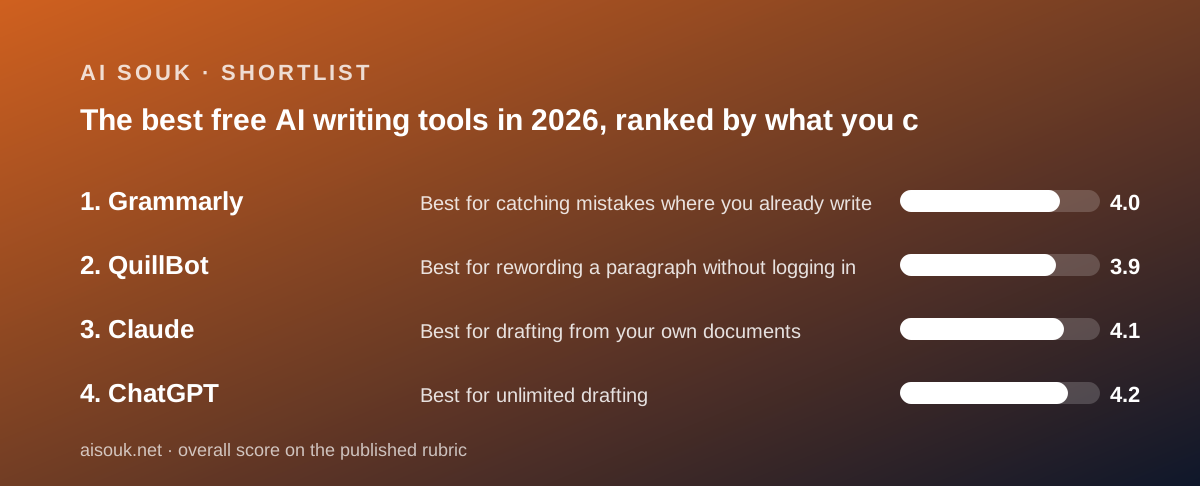
Free AI writing tools come in two kinds, and most people only compare within one. Correctors - Grammarly and QuillBot - sit where you already write and fix or reword what is there. Generators - ChatGPT and Claude - are destinations you go to for a draft. The free tiers meter completely different things: Grammarly rations the rewrites, QuillBot rations the words per pass, ChatGPT rations everything except text, and Claude rations a single usage pool. This shortlist ranks all four by what a small business can get done on the free plan, as documented by the vendors in October 2026, with the AI-detection and plagiarism questions answered honestly. No account was opened for this page.
Our picks
The most useful thing to understand about free writing tools is that the two kinds are not competing for the same job, even though the marketing suggests they are. Grammarly and QuillBot are correctors: they take text you have already written and underline, reword, shorten or translate it. ChatGPT and Claude are generators: they take a request and produce text that did not exist. A corrector is a reviewer of your sentence; a generator is a ghostwriter of it. The free tiers follow that split. Grammarly's free plan, per the plans page as of October 2026, is spelling, grammar and punctuation correction, tone detection, and 100 generative AI prompts a month. QuillBot's is every tool except plagiarism checking, each capped to a paragraph or a short page. ChatGPT's is unlimited text chat with the default model and capped everything else. Claude's is a single usage allowance that spans web search, file creation, projects and the rest. The right question is not which is best but which job you have, and the second question is how the free tier meters that job. Most owners end up with one of each kind, and because both are free, there is no cost to finding out which pair fits.
The correctors first, because their caps are the most precisely published. Grammarly's free tier catches mistakes wherever you write - browser extension, Windows and macOS apps, mobile keyboard, Microsoft and Google office suites - and shows you how an email reads in tone. What it does not do is change the writing: full-sentence rewrites, tone adjustment and the fluency tools for second-language writers are all Pro, per the plans page, as are plagiarism and AI-text detection. The 100 monthly prompts refill on the anniversary of the day generative AI first appeared in the account, per a support article, not on the first of the month. QuillBot's help centre lists free caps tool by tool: the paraphraser at 125 words with Standard and Fluency modes only, the summariser at 1,200 words, the translator at 5,000 characters, the AI detector at 1,200 words and ten scans a day, 20 AI chat queries a day, and the grammar checker with no cap listed. Nothing conceptual is withheld except plagiarism checking; the upgrade buys length and modes. Someone rewriting a cover letter paragraph by paragraph is inside those caps; someone paraphrasing a 2,000-word report is feeding it in sixteen pieces.
The generators meter by a different logic, and it changes what free is for. ChatGPT's pricing page says text chat is unlimited on the free plan with the default model, subject to abuse guardrails, while uploads, image generation, voice, deep research and memory each carry a separate unpublished cap. For drafting, rewriting and summarising pasted text, the core writing use is not metered at all, which is why public reports describe a free ChatGPT account as a usable daily writing assistant rather than a trial. Claude's free plan, per its pricing page, includes web search, file creation, Artifacts, memory, app connections and up to five projects on the Sonnet and Haiku models, metered as one allowance that the help center describes as resetting every five hours and varying with demand. The practical difference for a writer: on ChatGPT a long day of plain drafting does not run out; on Claude a long day of anything draws down the same pool, but a project holding your style guide, product sheet and past proposals is cached and counts less against the limit when reused. One is built for volume; the other is built for context.
Here is the limit no cap describes, and it applies to all four. A paraphraser is a rewording engine, not a reviewing one: users on public forums and in published reviews consistently report that paraphrasers can change meaning subtly - softening a hedge, swapping a technical term for a near-synonym that is wrong in context, producing a sentence that is grammatical and hollow. A grammar checker is reliable on mechanical errors, occasionally wrong on style, and accepting every suggestion flattens a distinctive voice. A generator invents: it will produce a confident paragraph about your return policy whether or not it has read your return policy. The discipline is the same across all four and it does not cost anything: read the output as carefully as you would read a stranger's edit of your work, because that is what it is. QuillBot's Fluency mode, which the vendor describes as fixing grammar while changing as little as possible, is the safer of its two free modes for anyone who cares about meaning. On the generators, pasting the source material into the request rather than relying on memory is the equivalent precaution.
The first trap is the detection feature, which people most often want and least often understand. Grammarly's AI-text detection and plagiarism checking are both Pro-only, per the plans page. QuillBot's AI detector is free at 1,200 words and ten scans a day; its plagiarism checker is Premium-only, with a documented 25,000-word monthly limit even on Premium. Two different things are being sold here and they deserve different trust. Plagiarism detection compares text against published sources and is a defensible check. AI-text detection produces a probability, not a verdict, and no detector is reliable enough to make a consequential decision on; anyone using one to judge a student, a contractor or a job applicant is treating a probabilistic signal as evidence. Checking your own draft before a client sees it is a reasonable use of the free QuillBot scan. Deciding whether someone else wrote their own work is not a use any free or paid tier here supports, whatever the marketing implies.
The second trap is what happens to your text, and the four vendors are at different stages of saying so. Grammarly's privacy policy states user content is used to develop and improve AI subject to your settings, and documents an account-level control; the default state of that control on a new free account is not something this site could verify from the pages. QuillBot's privacy page returned an access error on October 7, 2026, so this site cannot describe how QuillBot uses or retains the text you paste, which for a tool whose entire function is receiving your text is a gap worth weighing. ChatGPT publishes a training opt-out toggle and a Temporary Chat mode not used for training. Claude documents a training toggle, incognito chats excluded from training, and connector content excluded from training data. For an owner pasting contracts, client emails or unreleased product copy, the setting to find on day one is different on each tool and the answer on one of them is currently unavailable.
The third trap is where the tool runs, because for writing the friction is the product. Grammarly's distinguishing feature has always been that it follows you - into web forms, email clients, documents - and its free correction layer runs in all of those places, which is why it is the lowest-effort tool here: there is almost no learning curve because it appears where you already write. QuillBot lists browser and office-suite extensions on the free tier, and its paraphraser works without a login for basic use. ChatGPT and Claude are destinations: you go to them, paste, wait, copy back. For a one-off proposal that is nothing; for forty emails a day it is a tax, and the honest reason many people keep Grammarly free alongside a generator is that the generator drafts and the corrector catches the typo in the reply you typed yourself. The free tiers are complementary, not alternatives, and a stack of two costs the same as a stack of one.
Second-language writers are the group for whom the free lines fall differently, and it is worth saying so. The fluency tools - the ones that take a grammatical but unnatural sentence and make it read like a native speaker's - are Pro on Grammarly, per the plans page. QuillBot's Fluency paraphrasing mode is free, at 125 words a pass, and the translator is free to 5,000 characters. ChatGPT and Claude will rewrite a paragraph for fluency on request, with ChatGPT's unlimited text making it the cheapest high-volume route and Claude's projects letting you keep a glossary of terms you want preserved. Public forum reports describe the generators as better at keeping meaning intact than a paraphraser when asked to improve fluency, which matches how the tools work - a generator has the whole paragraph as context, a paraphraser has the sentence - but that is a report, not a measurement, and your own paragraph is the test.
When the free tier stops being enough, the first paid step is where these four diverge most. Grammarly Pro is $12 a member a month billed annually or $30 billed monthly, per the Pro page as of October 2026, with a seven-day trial; the monthly price is two and a half times the annual rate, so the cheap figure requires a year. QuillBot Premium is $19.95 a month or $99.95 a year, which the vendor presents as $8.33 a month, with a documented option to pause the subscription and pay only in the months you write. ChatGPT's Go plan at $8 a month loosens the free caps on uploads, images and memory, and Plus at $20 adds the advanced models, projects and custom GPTs. Claude's Pro is $20 a month or $17 annually, with the stronger models and more usage, and no cheaper rung. The vendors' own pages disagree with themselves in places - Grammarly's support article still quotes an older prompt count, QuillBot's FAQ describes its middle plan two incompatible ways - so the live checkout is the only price.
Choosing by situation. If you write in English all day in email and documents and want mistakes caught where they happen, Grammarly's free tier is the product, and the Pro upsell - visible as a count of withheld suggestions - is a design choice you can ignore. If you regularly need a sentence or a paragraph said differently, QuillBot's free paraphraser does that without a login, in 125-word pieces, and the annual price is low enough that the real question is whether a free generator would do the job instead. If you draft a lot and want it unmetered, ChatGPT's unlimited text is the deciding fact. If you draft from your own material - a brand voice, past proposals, a product catalogue - Claude's free projects with cached content fit that workflow better than any other free plan here. For the two correctors head to head, this site has a longer side-by-side at Grammarly vs QuillBot, and for the two generators at ChatGPT vs Claude. Suggestion quality, the thing people most want ranked, is not something documentation can grade; one real paragraph through each tool will tell you more than this page can.
Best for catching mistakes where you already write: Grammarly
Grammarly's free plan is three things, in the vendor's own phrasing on the plans page as of October 2026: write without spelling and grammar mistakes, see your writing tone, and generate text with 100 AI prompts a month. The first of those runs everywhere - browser extension, Windows and macOS apps, mobile keyboard, Microsoft and Google office suites - which is why it is the lowest-friction tool on this list and the one most people will actually keep using. What the free tier does not do is the two things people assume it does: it will not rewrite a whole sentence with one click, and it will not check plagiarism; those, along with tone adjustment, fluency for second-language writers and AI-text detection, are Pro. The 100 prompts refill on an account anniversary rather than the first of the month, per a support article. Public forums describe the free experience as a constant count of withheld Pro suggestions, which is a design choice rather than a fault. The privacy policy states content is used to improve AI subject to your settings; check the default. Pro is $12 a member a month billed annually or $30 monthly, with a seven-day trial and 2,000 prompts - though a still-live support article quotes an older, lower figure.
Visit Grammarly
We have no affiliate relationship with this vendor. Link goes to the official site.
Best for rewording a paragraph without logging in: QuillBot
QuillBot's free tier is the product at reduced size, plus one missing tool, and the help centre documents every cap so there is no guessing. As of October 2026: the paraphraser handles up to 125 words a pass in Standard and Fluency modes, with three synonym settings and no history; the summariser takes 1,200 words; the translator 5,000 characters; the AI detector 1,200 words and ten scans a day; 20 AI chat queries, three image generations and three presentation generations a day; the grammar checker with no cap listed; and browser and office-suite extensions. The plagiarism checker is Premium-only, with a 25,000-word monthly limit even then. The 125-word cap is the upgrade pressure - a long report goes in sixteen pieces - and it is honestly stated. Two cautions. A paraphraser can change meaning subtly, and Fluency is the safer free mode for anyone who cares about it. And the vendor's privacy page returned an access error on October 7, 2026, so this site cannot say how pasted text is used or kept. Premium is $19.95 a month or $99.95 a year (about $8.33 a month), with a documented option to pause the subscription in months you do not write.
Visit QuillBot
We have no affiliate relationship with this vendor. Link goes to the official site.
Best for drafting from your own documents: Claude
Claude is the generator to choose when the draft has to sound like you and know your material. The free plan, per the pricing page as of October 2026, includes up to five projects, file creation, web search, Artifacts, memory across conversations and app connections, on the Sonnet and Haiku models, with Opus and Fable reserved for Pro. The help center states that content in projects is cached and counts less against your limits when reused, which is the fact that matters for a writer: put the brand voice guide, the product sheet and three past proposals into a project once, and every draft after that is written against them without re-pasting. Usage is one allowance with no fixed message count, described as a session-based limit resetting every five hours and varying with demand, so a long afternoon of drafting can hit the wall; public reports say starting a new chat helps, which matches the help center's note that conversation history consumes usage. Data controls are documented, including incognito chats excluded from training. The first paid step is $20 a month, or $17 annually, with no cheaper rung - larger than ChatGPT's $8 Go - which is the main reason it sits below ChatGPT for pure volume.
Visit Claude
We have no affiliate relationship with this vendor. Link goes to the official site.
Best for unlimited drafting: ChatGPT
ChatGPT's place here rests on a single line of the pricing page, as of October 2026: unlimited text chat with the default model on the free plan, subject to abuse guardrails. For a writer that means drafting, rewriting, shortening, changing tone and summarising pasted text are not metered - the only free tier on this list where the core writing use has no cap at all, and the reason public reports describe a free account as a daily writing assistant rather than a trial. What is capped, each with an unpublished limit that pauses independently, is everything around the text: file and image uploads, image generation, voice, deep research, memory and context. The practical consequence for writing is that pasting a document into the chat is unlimited while uploading it as a file is not, so paste. Free users get 500 MB of storage, can use existing GPTs but not build their own, and the help center states ads may appear in certain regions. A training opt-out toggle and a Temporary Chat mode not used for training are documented. The first paid step is Go at $8 a month, which loosens the upload, image and memory caps; Plus at $20 adds the advanced reasoning models, projects and custom GPTs, which is where organised writing work begins.
Visit ChatGPT
We have no affiliate relationship with this vendor. Link goes to the official site.
How we chose
Four tools were ranked: the two correctors with the largest documented free tiers and the two general assistants most often used for drafting. The ranking rests on what each vendor's plans page or pricing page lists on the free tier as of October 7, 2026; how the allowance is metered (per-tool word caps, monthly prompts, unlimited text, or one usage pool); which writing jobs are withheld to the paid tier; what the privacy policy says about training on your text; and where the tool runs, since friction decides whether a writing tool gets used. Sources were the vendors' plans and pricing pages, help centres and support articles, privacy policies where reachable, and public user reports used only where they match the documentation. No account was opened and no text was run through any tool for this page, so suggestion quality is not graded and no claim is made about it. Where vendor pages disagree with each other - Grammarly's prompt counts, QuillBot's billing descriptions - both versions are reported. Where a page was unreachable - QuillBot's privacy page - the gap is stated rather than filled. Prices are US and change often.
Frequently asked
Which free writing tool rewrites whole sentences?
Grammarly's one-click sentence rewrite is Pro-only per its plans page as of October 2026; the free tier corrects and shows tone. QuillBot's free paraphraser rewrites up to 125 words a pass in two modes. ChatGPT and Claude will rewrite any length on request, with ChatGPT's text unmetered on free and Claude's drawing from a single usage allowance.
Can I check for plagiarism or AI-written text for free?
Plagiarism checking is paid on both correctors - Pro on Grammarly, Premium on QuillBot with a 25,000-word monthly cap. QuillBot's AI detector is free at 1,200 words and ten scans a day; Grammarly's is Pro. AI-text detectors produce a probability, not a verdict, and should not be used to make decisions about other people's work.
Do these tools train on what I paste?
Grammarly's privacy policy says content is used to improve AI subject to your settings, with an account-level control. ChatGPT and Claude publish opt-out toggles and temporary or incognito modes. QuillBot's privacy page was unreachable on October 7, 2026, so this page cannot say. Read the current policy before pasting anything confidential.
What is the cheapest upgrade if the free tier runs out?
As of October 2026: ChatGPT Go at $8 a month, QuillBot Premium at $99.95 a year (about $8.33 a month, with a pause option), Grammarly Pro at $12 a member a month billed annually ($30 monthly), and Claude Pro at $20 a month or $17 annually. Which is cheapest depends on whether you need volume, modes, reach or context. All prices change; check the current page.