 AI
AIChatGPT vs Claude on the free tier: which one to open first
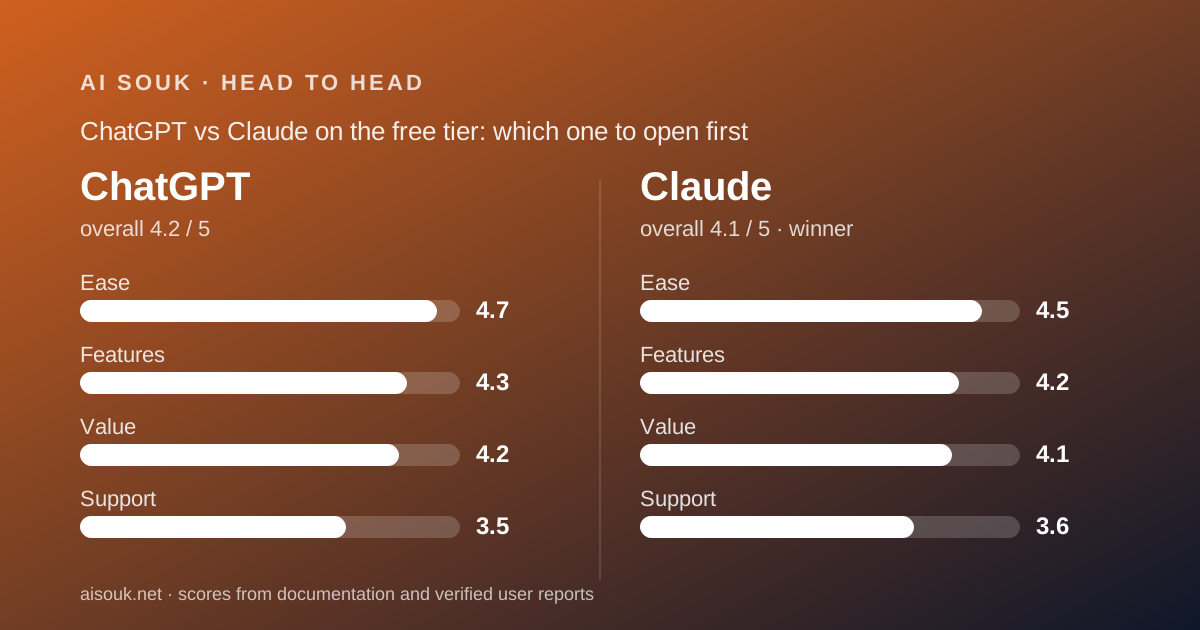
Both free plans are good enough to do real work, which is exactly why the choice is hard. ChatGPT gives you unlimited plain text chat and meters everything else. Claude gives you a richer toolset on day one and meters the whole thing with one allowance. Short answer: if your work lives in documents, files and projects, open Claude first; if you mostly want a tireless writing partner for short tasks all day, open ChatGPT. This page compares the two from the vendors' own pricing pages and help centers as of October 2026, with no first-hand account and no invented numbers.
 4.2ChatGPT
 4.1Claude
The short answer
This is a documentation comparison, not a walkthrough: it draws on the pricing pages, help centers and privacy documents that OpenAI and Anthropic published as of October 2026, and it does not describe what either interface looks like today. The two underlying reviews on this site, ChatGPT and Claude, hold the detail; this page is about the decision.
The decision comes down to the shape of the free tier rather than its size, because neither vendor publishes the size. ChatGPT's free plan is built around one unmetered promise, unlimited text chat with the default model, and a ring of capped extras: uploads, images, voice, deep research, memory. Claude's free plan is built around a wider set of working tools, projects, web search, file creation, code execution and app connections, all drawing on a single usage allowance that Anthropic says has no fixed message count.
Claude edges this comparison for a small-business reader because the things you need to do a job, not just a chat, are on its free plan: a project that remembers your reference material, a generated file you can download, a search that fetches today's page. ChatGPT wins the plain-volume case and has the cheaper first paid step. It is close, and the sections below say where it tips each way.
What each free tier includes (as of October 2026)
OpenAI's pricing page, checked October 7, 2026, describes the free plan in eight lines. The first is unlimited text chats with GPT-5.6 Luna, the default model, subject to abuse guardrails. The other seven all begin with the word limited: messages with uploads, image creation, voice chats, deep research, memory and context, Codex access, and ChatGPT Work access on desktop. The help center's free tier FAQ confirms that free accounts get web search, data analysis, image and file uploads, image generation, the ability to use existing GPTs (but not create or publish them), and 500 MB of cloud storage. It also states that ads may appear for free users in certain regions.
Anthropic's pricing page, checked the same day, lists the free plan at $0 with five capability lines: chat on web, desktop and mobile; search the web, create files and run code; memory across conversations; connect your apps and tools; and create Artifacts. It also states that free accounts get up to five projects. The restrictions are on the model line, Sonnet and Haiku only, with Opus and Fable reserved for Pro and above, and on the specialist surfaces: Claude Code, the Research feature, Claude Science and Claude Design are marked as not included on free.
Put side by side, the lists differ in kind. ChatGPT's free extras are mostly media and modality: images, voice, uploads. Claude's free extras are mostly workflow: projects, connectors, file creation. If you want to talk to an assistant, dictate to it, or have it draw something, ChatGPT's list is longer. If you want it to work inside a folder of your own documents and hand you back a finished file, Claude's list is longer. Neither page names a number for the free quantity of anything except ChatGPT's storage and Claude's five projects, and this page will not fill that gap.
Daily limits and what happens when you hit them
Here the two products are honest in different ways. OpenAI's help center describes the mechanism without the quantities: each capped tool carries its own rate limit, ChatGPT notifies you when you reach one, and that tool pauses until the limit resets, with the timing shown in the app. The FAQ adds that the default model and its limits can change over time. Because the limits are per tool, running out of image generations does not stop you chatting, and running out of upload messages does not stop you using voice. Plain text never runs out, which is the single most important fact about the free plan.
Anthropic's pricing page says there is no fixed message count because usage depends on the complexity of what you ask. The help center's usage guidance, which was reachable when checked, lists what spends the allowance: message and attachment length, conversation history, tool use such as web search, the model chosen, Artifact creation and multi-step tasks. The help center describes free usage as a session-based limit that resets every five hours, with the number of messages varying by demand; that wording comes from the article as indexed by search, because the article's own page was not reachable when checked, so treat it as reported rather than quoted. One documented lever matters: content in projects is cached and counts less against your limit when reused.
The practical difference is this. On ChatGPT a free user learns which features are precious, spends them deliberately and chats freely in between. On Claude a free user learns that a forty-page attachment pasted into a fresh chat is expensive and a project is cheap, and works in sessions rather than all day. Public forum discussion matches both documents: ChatGPT users complain that upload and image caps arrive sooner than expected on a busy day; Claude users complain that long conversations exhaust the allowance and that starting a new chat helps. Neither complaint contradicts the vendor; both describe the design.
Quality of output for everyday work
This page cannot grade output quality from documentation and will not pretend to. What it can do is say which model each free plan gives you and what the vendors say that model is for.
ChatGPT's free model is the default, GPT-5.6 Luna per the pricing page; the advanced reasoning models with GPT-6 are listed under Plus, and the Pro reasoning tier under Pro. Claude's free models are Sonnet and Haiku; the pricing page lists Opus and Fable for Pro and above. In both cases, then, the free user gets the vendor's mid-range model and pays for the top of the line. There is no documented free route to either vendor's strongest reasoning model.
What the free plans let that model do differs more than the model itself. On Claude, the free model can search the web, write and run code, and produce a downloadable file or an Artifact, so an everyday task like turning meeting notes into a formatted document ends with a document. On ChatGPT, the free model can search, analyse data and generate an image, but projects, scheduled tasks and custom GPTs are Plus features, so the organised, repeatable version of a task is paid. For one-off drafting and rewriting, where the output is the text itself, both free tiers are complete products and the choice is taste. For anything with a file at the end of it, Claude's free tier gets further before asking for money.
Public reports of quality are consistent across the two: users describe both free models as reliable on summarising, drafting and explanation, and both as weaker than their paid siblings on long multi-step reasoning. That matches what the pricing pages sell, and it is as far as the documents allow this page to go.
Privacy and training defaults
Both vendors use consumer conversations for training by default and both publish a control, so the question is how good the control is and what sits outside it.
OpenAI's data controls FAQ states that conversations on consumer accounts can be used to train models, and names the setting, Improve the model for everyone, which when turned off stops new conversations from being used. A Temporary Chat mode exists whose chats are not used for training and do not appear in history, but which the FAQ says may be retained for up to 30 days for safety purposes. Memory is a separate control; turning it off does not change training. Business, Enterprise and Edu workspaces are excluded from training by default.
Anthropic's privacy center article frames training as a choice in your privacy settings. Incognito chats are excluded from training even when the setting is on. Two details are useful for a business reader: raw connector content, such as files reached through a connected Google Drive, is excluded from training unless you paste it into a conversation yourself, and thumbs-up and thumbs-down feedback is stored for up to five years, de-linked from identity before use. The article does not state a retention period for ordinary chat data, and this page will not guess one.
On the documents, Claude's defaults are slightly more protective for a business that connects its tools, because the connector exclusion is explicit. On ChatGPT the equivalent protection is a workspace plan rather than a setting. In both cases the rule is the same: visit the toggle on day one, use the incognito or temporary mode for anything you would not want in a training set, and keep client and regulated material out of a consumer free account altogether.
Price of the first paid step
This is where ChatGPT pulls ahead, and it is not close. OpenAI's pricing page as of October 2026 lists Go at $8 a month, Plus at $20 and Pro from $100. Go is described as a loosening of the free fences: more messages with tools, more uploads, more image creation, more voice chats and longer memory, without the advanced reasoning models or the organisational features. Plus is the first tier with projects, scheduled tasks, custom GPTs and the GPT-6 reasoning models.
Anthropic's pricing page lists Pro at $20 a month, or $17 a month on an annual plan billed at $200 a year, and Max from $100 with 5x and 20x the Pro usage. Pro buys more usage, the full model line including Opus and Fable, Claude Code, the Design, Slides and Docs tools, Claude Science, and the Chrome and Microsoft 365 integrations. There is no cheaper intermediate step; if the free allowance is nearly enough, there is no $8 way to buy a little more.
So the upgrade math runs like this. A free ChatGPT user who keeps hitting the upload or image wall can spend $8 and stay on the same model. A free Claude user who keeps hitting the five-hour window spends $20 and gets, along with more usage, a materially stronger model and a set of professional tools. The ChatGPT step is cheaper; the Claude step changes more. Which is better depends on whether the thing you ran out of was quantity or capability. Prices on both pages have changed before and both pages say they can change again; read the current page before deciding.
Pick this one if…
Pick Claude if your work involves a recurring set of documents. Five free projects with cached content, plus web search and file creation, is the right shape for a bookkeeper, a consultant or anyone who answers the same questions from the same source material every week.
Pick ChatGPT if you chat with an assistant all day in short bursts. Unlimited text with the default model is the only unmetered promise on either page, and it suits a writer, a support desk or an owner who wants a second opinion forty times a day.
Pick ChatGPT if you want voice or images on a free plan. Both are capped, but both are present; Claude's free plan does not list either.
Pick Claude if you connect tools. Free app and tool connections, with connector content explicitly excluded from training, is a combination ChatGPT's consumer tiers do not offer on free.
Pick ChatGPT if your first upgrade budget is under $10. The $8 Go tier is the cheapest way in this pair to make the free walls move. Pick Claude if your first upgrade should buy a stronger model and real production tools, and $20 is acceptable.
Frequently asked
Can both be used for free indefinitely? Yes, on the documents. Neither free plan is a trial with an end date. ChatGPT's FAQ warns that the default model, the limits and the presence of ads in some regions can change; Anthropic's page says the allowance varies with demand. Indefinite is not the same as stable.
Which one gives more free messages? Neither vendor publishes a number, so this page cannot say. ChatGPT publishes that plain text is unlimited, which is a stronger statement than Claude's. Claude publishes that project content is cached and counts less, which is a lever ChatGPT's free plan does not document. If you measure by plain chat, ChatGPT; if you measure by work done per session on your own files, the documents favour Claude.
Is it worth running both? For a small business, yes, and it costs nothing. Use ChatGPT for the unlimited drafting and the capped images and voice, and Claude for projects that hold your documents. The privacy work doubles: two training toggles to visit, two incognito modes to learn, and the same rule about client material applying to both. Related reading on this site: Gemini for a Google-centred alternative with a $4.99 first step, and Perplexity if the job is research with sources rather than drafting.
Visit ChatGPT
We have no affiliate relationship with this vendor. Link goes to the official site.
Visit Claude
We have no affiliate relationship with this vendor. Link goes to the official site.