 AI
Zapier vs Make free: 100 tasks or 1,000 credits
This comparison is built from both vendors' public pricing pages and help centres, read on October 11, 2026, not from logged-in accounts, so nothing below is a first-hand claim about either editor. On the published figures the free plans are not close: Zapier lists 100 tasks a month and two-step workflows only, Make lists 1,000 credits a month with routers and filters included. Zapier answers with a directory of 10,240+ apps against Make's 3,500+. Make wins this on the free tier and on price; Zapier wins it on coverage and on the first ten minutes.
 3.8Make
The short answer
Both are permanent free plans. Both need no card. They are generous in different columns, and the column that matters depends on whether your problem is volume or coverage.
- Zapier is best for the person whose two apps are obscure, who wants one automation live this afternoon, and whose automation is genuinely two steps
- Make is best for the person whose free allowance has to do a month of real work, whose workflow branches, and who will pay eventually and wants the cheapest escape hatch
- Winner on the free tier: Make. 1,000 credits against 100 tasks, routers and filters included, and a first paid step at $9 a month against $19.99
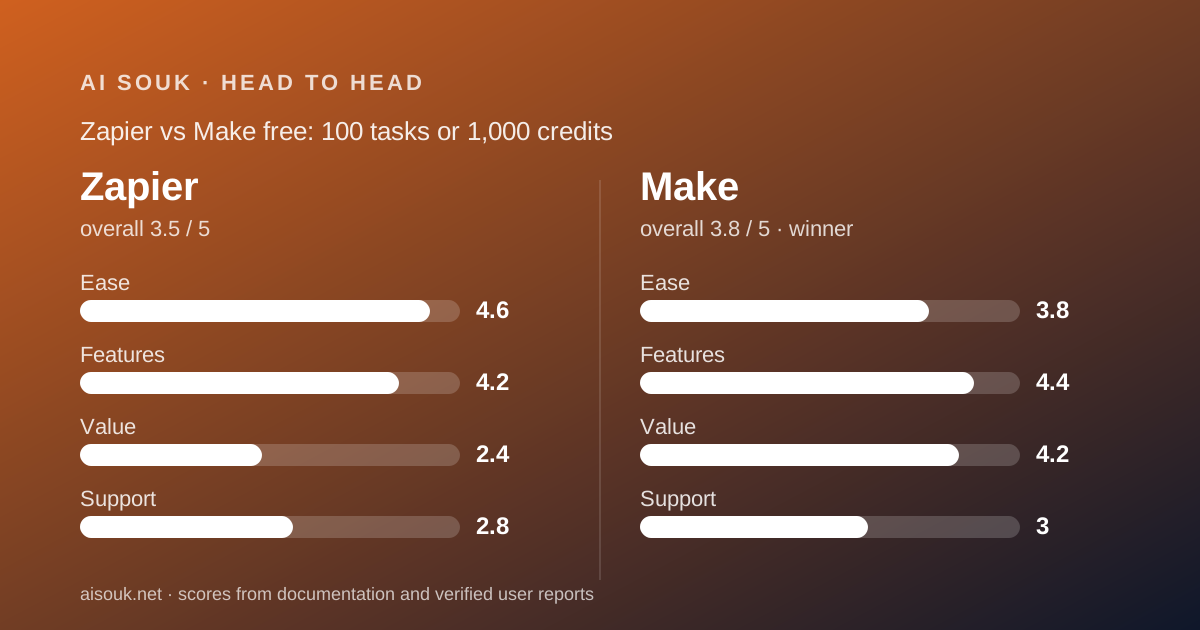
The numbers side by side (read October 11, 2026)
Every row below was read from the vendor's own pricing page or help centre on October 11, 2026. Rows marked not published mean the vendor does not state the figure, not that there is no limit.
- Free plan price: Zapier $0, permanent, no card / Make $0, permanent, no card
- Free allowance: Zapier 100 tasks a month / Make 1,000 credits a month
- What the unit counts: Zapier successful action steps / Make operations, at 1 credit per operation for non-AI apps
- Active automations on free: Zapier unlimited Zaps / Make 2 active scenarios
- Steps per workflow on free: Zapier 2, one trigger and one action / Make no published cap
- Branching on free: Zapier no, Paths is a paid feature / Make yes, routers and filters are listed on Free
- Minimum interval on free: Zapier 15 minutes / Make 15 minutes
- Execution ceiling on free: Zapier not published / Make 5 minutes per run
- Data transfer on free: Zapier not published / Make 512 MB a month
- Apps listed: Zapier 10,240+ / Make 3,500+ standard apps and 350+ AI apps
- First paid step: Zapier $29.99 a month, or $19.99 billed annually, for 750 tasks / Make Core at $9 a month for 10,000 credits
- Second paid tier: Zapier Team $103.50 a month, or $69.00 billed annually, for 2,000 tasks / Make Pro at $16 a month
- AI on the free plan: Zapier Copilot with an unpublished daily limit, plus basic AI access / Make Maia, AI applications, AI Agents in beta and the AI Toolkit, listed on all plans
- Self-hosted option: neither vendor offers one
- Trustpilot on October 11, 2026: Zapier 1.3 out of 5 from 322 reviews / Make 2.7 out of 5 from 173 reviews
Make's free plan does roughly ten times the work
This is the single fact that decides the comparison for most readers, and it is not close.
Zapier's pricing page lists 100 tasks a month on Free. Make's lists 1,000 credits a month. The units are defined differently, but both count work performed by the platform, and the ratio is ten to one.
By our own arithmetic, 100 successful actions a month is about three a day. 1,000 credits is about thirty. One of those is an evaluation budget and the other is a small working system.
Zapier's mitigation is real and worth knowing. Its help centre states that triggers, Filter and Paths steps, errored actions, and Formatter, Delay, Looping, Digest, Storage, Zapier Manager, Tables and Forms steps do not count. So a Zap that fires 200 times but filters down to 40 real actions costs 40 tasks.
Make's definition is tighter in one direction. The help centre states that only features triggered by scenario runs, or the AI agent's chat, consume credits, and that one operation equals one credit for non-AI apps.
Neither vendor's unit is the number on the marketing page. The habit of checking what the meter actually counts is the subject of our note on what AI credits actually mean.
Make's limit is the two-scenario cap, not the credits
Make gives away the allowance and takes back the concurrency, and that trade is the main reason some readers should still pick Zapier.
The pricing page lists maximum active scenarios on Free as 2, against unlimited from Core upward. Zapier lists unlimited Zap workflows on Free.
So the shapes are opposite. Make lets two automations do a lot. Zapier lets many automations do very little.
If your work is two important jobs, Make is clearly better. If it is ten small jobs that each fire twice a month, Zapier's unlimited Zaps may actually fit inside 100 tasks and Make's two-scenario cap will not stretch.
There is a documented workaround on Make's side: the cap is on active scenarios, not stored ones, so you can build a library and switch two on. That helps seasonal work and does nothing for ten daily jobs.
Make also publishes two ceilings Zapier does not state at all on the free plan: 5 minutes maximum execution time and 512 MB of data transfer a month. A scenario looping over a few hundred records can run into the first of those.
Branching is free on Make and paid on Zapier
Make's pricing page lists routers and filters on the Free plan. Zapier's free plan is limited to two steps, and Paths is a paid feature.
That difference is larger in practice than either pricing page makes it look, because most real automations branch by the second month. A form submission that goes to one list if the person ticked a box and another list if they did not is a branch.
On Zapier's free plan you cannot build that. You can build two separate Zaps with filters, since filters are free and do not consume tasks, and that covers simple cases at the cost of duplicated setup.
On Make's free plan you place a router and both paths live in one scenario.
The counterweight is that Zapier's restriction also protects beginners. Two steps is hard to get wrong. A canvas with routers, iterators and aggregators is a steeper first hour, and a third of Make's public reviewers complain specifically about complexity.
Zapier is three times the directory, and sometimes that settles it
Zapier's app directory stated 10,240+ apps on October 11, 2026. Make's pricing page stated 3,500+ standard apps and 350+ AI apps.
If the integration you need exists only in the larger directory, every price comparison above becomes irrelevant. A tool that cannot reach your booking system is not cheap, it is useless.
So the correct order of operations is to search both directories for both ends of your automation before you compare any numbers. Both directories are public and neither requires an account.
The gap matters most for narrow vertical software: clinic booking, trade invoicing, regional payment processors, small-market e-commerce platforms. It matters least for the obvious tools, which are in both.
For AI steps specifically, both platforms carry connectors for the major model providers, so either can hand a message to ChatGPT and act on the reply. Both bill twice when you do that: once in their own unit, once in the model provider's tokens.
Pricing: Make is cheaper at every published step
Read from both pricing pages on October 11, 2026.
First paid step: Make Core at $9 a month with 10,000 credits. Zapier Professional at $29.99 a month billed monthly, or $19.99 a month billed annually, with 750 tasks.
Second step: Make Pro at $16 a month. Zapier Team at $103.50 monthly, or $69.00 billed annually, with 2,000 tasks.
Third step: Make Teams at $29 a month. Zapier's Professional tier scales by task volume up to figures the page prices at $5,099 a month billed monthly.
Both vendors charge for throughput rather than for seats, so a one-person shop and a ten-person team running the same automations pay roughly the same. Make's Teams tier is where team roles and scenario templates arrive; Zapier's Team tier is where shared connections do.
Make describes the Pro annual plan as saving 15 percent or more. Zapier describes its annual billing as a 33 percent discount. Neither published percentage was independently recalculated for this page.
If you are already deciding whether to pay, our checklist for leaving a free tier sets out the questions worth answering before the first invoice.
Neither free plan runs faster than every 15 minutes
This is the one row where the two are identical, and it is worth stating because it catches people out.
Both pricing pages list a 15-minute minimum interval on the free plan. Zapier calls it update time; Make calls it minimum scheduling interval. Either way, a scheduled automation on a free plan can wait a quarter of an hour before it notices anything.
That makes both free plans unsuitable for anything a customer is waiting on. A support auto-reply that arrives fourteen minutes late is worse than no auto-reply.
Paid plans diverge: Zapier lists 2 minutes on Professional and 1 minute on Team; Make lists 1 minute from Core upward, which is the cheaper route to fast polling by a wide margin.
Webhook-triggered automations are the exception on both platforms, since a webhook arrives rather than being polled for. Neither free plan's documentation that we read on October 11, 2026 put a published limit on that.
Make gives away more of its AI layer
Make's pricing page lists Maia by Make, the AI applications, Make AI Agents in beta and the Make AI Toolkit across all plans, including Free, as of October 11, 2026.
Zapier's pricing page lists Copilot with a daily limit and basic access to AI products on Free, and does not publish the number behind the word limit.
So on published terms, a free Make user can use the conversational builder and the agents beta; a free Zapier user can sample Copilot an unstated number of times a day.
Neither gives the AI away free of metering, and this is the part most readers miss. Make's help centre states that third-party AI apps cost one credit per operation plus token usage, and that some built-in modules, such as certain AI Content Extractor modules, consume more than the default one credit per operation. Zapier charges a task for each successful AI action step.
In both cases a model call also consumes the model provider's own allowance. Budget for two meters, not one.
Support: both public records are poor, Zapier's is worse
Read from Trustpilot on October 11, 2026, and offered as sentiment rather than measurement.
Zapier: 1.3 out of 5 from 322 reviews. The repeated themes are a strict no-refund stance, unexpected auto-renewal charges, and support replies that quote policy rather than solve problems.
Make: 2.7 out of 5 from 173 reviews, split roughly half five-star and a third one-star. The repeated complaints are complexity, slowness of the web app, and scenarios breaking after platform updates. The repeated praise is the free tier and, in some accounts, support that went well beyond expectations.
Two cautions. Trustpilot attracts billing disputes, so both scores run below what a representative survey would show. And a few hundred reviews is a small sample against either user base.
On documentation the ranking reverses in part. Zapier's help centre publishes an itemised list of what does and does not count as a task, which is the clearest metering document either vendor has. Make publishes its hard ceilings on the pricing page itself, which Zapier does not.
We did not contact either support desk and make no claim about response times. Make lists customer support on the free plan; Zapier does not state a support channel for Free on its pricing page.
Privacy: neither published an answer we could read
Both platforms are hosted only. Neither offers a self-hosted edition, so in both cases every record your automation touches passes through the vendor's systems.
We looked for a plain published statement from each vendor about whether customer data is used to train models for the AI features. Several candidate pages on zapier.com returned 404 when fetched on October 11, 2026. Make's AI page described the capabilities and the providers it connects to without addressing training.
So the honest position for both is that we could not read a published answer on that date, and we will not guess at one. Make's terms page links a master services agreement and a data processing agreement as PDFs, which is where that language would sit; those were not read for this page.
If training on workflow data is a blocker, get the answer in writing before you connect a system of record. Readers for whom this is the deciding question should look at n8n instead, whose self-hosted Community edition removes the question by removing the middle. The general shape of the problem is in our note on free AI tiers and your data.
Choose Zapier if, choose Make if
Both free plans are worth opening, and opening both costs nothing. If you only want one, this is the split.
- Choose Zapier if one end of your automation is a niche app that Make's 3,500+ directory does not list
- Choose Zapier if you want something running within the hour and would rather not learn a canvas
- Choose Zapier if you need many tiny automations rather than two busy ones, since Free allows unlimited Zaps
- Choose Make if your free allowance has to do real monthly work, at 1,000 credits against 100 tasks
- Choose Make if your workflow branches, since routers and filters are on the free plan
- Choose Make if you expect to pay, because Core at $9 a month is less than half Zapier's cheapest annual rate
- Choose Make if you want the AI builder and agents beta without upgrading
Frequently asked
Which has the better free plan? Make, on published figures read October 11, 2026. 1,000 credits a month against 100 tasks, and routers and filters included rather than paywalled.
Which is cheaper for a small team? Make. Core is $9 a month against Zapier Professional at $19.99 billed annually, and both vendors charge by throughput rather than per seat.
Is a task the same as a credit? No. A Zapier task is one successful action step. A Make credit is one operation for non-AI apps, with AI modules costing more. Compare the ceilings, not the words.
Can I move automations from one to the other? Not automatically. Neither vendor publishes an import path for the other's workflows, so a migration means rebuilding each automation by hand.
Which is better for AI steps? Make, on free-plan terms: Maia, the AI applications and the agents beta are listed on all plans. Both bill the model provider's tokens on top of their own unit.
Do I have to choose? No. Both free plans are permanent and need no card, and running one automation on each is the cheapest way to find out which interface you can live with.
Bottom line
Make wins this comparison on the free tier, on price and on branching. Zapier wins it on app coverage and on the first ten minutes.
If your automation is two steps between two obscure apps and it fires a few times a week, start with Zapier and the 10,240+ directory is the reason.
For everyone else, start with Make. Ten times the free allowance, logic included, and a paid escape hatch at $9 a month rather than $19.99.
The one thing to check before either: search both app directories for both ends of your automation. That takes two minutes, needs no account, and it overrides every other argument on this page.
Scored on our published rubric from documentation, pricing pages and verified user reports, not from accounts of our own. If you are assembling free tiers rather than buying one tool, read building a free-tier stack and how to read an AI free tier before you sign up next, and our starter kit for a small business owner for what belongs at either end.
Frequently asked
Which has the better free plan, Zapier or Make?
Make, on figures read October 11, 2026. Its pricing page lists 1,000 credits a month against Zapier's 100 tasks, and routers and filters are included on Free where Zapier paywalls branching and caps workflows at two steps.
Is a Zapier task the same as a Make credit?
No. A task is one successful action step; Zapier's help centre lists triggers, filters and several step types as free. A Make credit is one operation for non-AI apps, with some AI modules costing more than one. Compare the published ceilings instead.
Which is cheaper after the free plan?
Make. Core is listed at $9 a month with 10,000 credits, against Zapier Professional at $29.99 monthly or $19.99 billed annually with 750 tasks, per both pricing pages on October 11, 2026. Both charge by throughput rather than per seat.
Can I migrate my Zaps to Make?
Not automatically. Neither vendor publishes an import path for the other's workflows as of October 11, 2026, so a move means rebuilding each automation. That is an argument for testing both free plans before you commit to either.
Which handles AI steps better on the free plan?
Make, on published terms. Maia, the AI applications, AI Agents in beta and the AI Toolkit are listed on all plans. Zapier lists Copilot with an unpublished daily limit. Both consume their own unit plus the model provider's tokens.
Sources
- Zapier pricing page - checked October 11, 2026
- Zapier help centre: what counts as a task - checked October 11, 2026
- Zapier app directory - checked October 11, 2026
- Make pricing page - checked October 11, 2026
- Make help centre: what a credit is - checked October 11, 2026
- Trustpilot reviews for zapier.com and make.com - checked October 11, 2026
Visit Zapier
We have no affiliate relationship with this vendor. Link goes to the official site.
Visit Make
We have no affiliate relationship with this vendor. Link goes to the official site.