 AI
AIThe best free AI chat assistants in 2026, ranked by what the free tier actually lets you do
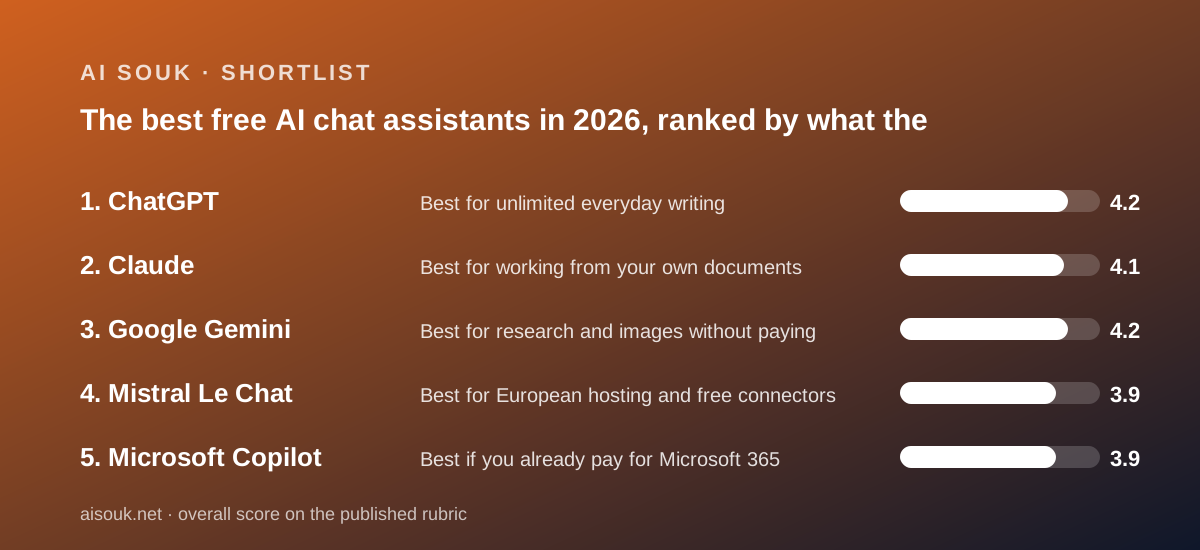
Every major chat assistant now has a free tier, and every vendor describes it with the same word: limited. This shortlist ranks five of them - ChatGPT, Claude, Gemini, Microsoft Copilot and Mistral's Le Chat - by what their documentation says the free plan actually does, not by which model scores highest on a benchmark. It is built from pricing pages, help centers and public user reports checked in October 2026; no account was opened for it. If you run a small business and want to know whether free is enough before paying $5, $8, $15 or $20 a month, the answer depends on how you work, and this page is organised around that.
Our picks
- Best for unlimited everyday writing: ChatGPT
- Best for working from your own documents: Claude
- Best for research and images without paying: Google Gemini
- Best for European hosting and free connectors: Mistral Le Chat
- Best if you already pay for Microsoft 365: Microsoft Copilot
Two years ago the question was which assistant was smartest. In October 2026 the models at the top of each vendor's ladder are close enough for everyday business writing that the question has moved: what does the free plan let you do, how often, and what happens when you run into the fence? That turns out to be a question the vendors answer in five different dialects. OpenAI's pricing page for ChatGPT says limited seven times without a number. Anthropic's page for Claude says there is no fixed message count. Google's support article for Gemini describes compute-based limits that refresh every five hours up to a weekly cap, with multipliers for paid tiers, and never states the base quantity. Microsoft's copilot.com says only that some capabilities are subject to usage limits. Mistral's pricing page describes Le Chat - renamed Vibe in August 2026 - with the word limited next to messages, searches and coding sessions. None of the five publishes the free allowance as a figure you could plan around. That is the first thing to accept, and it is why this list ranks by shape rather than size.
The shape of a free tier is how the metering works, and there are four shapes in this group. ChatGPT meters per feature: text chat is unlimited on the default model, per the pricing page as of October 2026, while uploads, image generation, voice, deep research and memory each carry their own separate, unpublished cap. Run out of images and you can still chat. Claude meters one pool: a single usage allowance, described in the help center as a session-based limit that resets every five hours, that every feature - web search, file creation, Artifacts, project reading - draws from at different rates. Gemini meters by compute, with the free quantity unstated and the paid tiers described as 2x, 4x and higher multiples of it. Copilot and Le Chat simply say limited and stop. If you want to predict your own experience, the shape matters more than the number, because it tells you whether the thing you use most is the thing that runs out first. A free user who mostly types will never meet ChatGPT's image cap; the same user on Claude spends the one pool with every message, however plain.
The second axis is which model answers you for nothing. ChatGPT's pricing page names a default model for free users and reserves the advanced reasoning models for Plus. Claude's page is explicit: Sonnet and Haiku on free, with Opus and Fable listed for Pro and above. Gemini is, as of October 2026, documented two ways on the same day: the subscriptions page lists 3.6 Flash and varying access to 3.1 Pro on the free plan, while the usage-limits article's table shows Flash-Lite only for accounts without a plan from October 9, 2026. Microsoft's consumer pages do not name the model behind free Copilot at all. Mistral's pages describe a fast-versus-think toggle in the merged product but do not state which model free users get on each side of it. For most drafting, rewriting and summarising, the default models are adequate; the stronger ones matter for long analysis, code and multi-step tasks. If that is your work, no free tier in this group gives you the top model, and the honest comparison is between the cheapest paid tiers rather than between the free ones.
The trade every free tier makes is between breadth of features and depth of usage, and the five land in different places. Claude is the broadest: the pricing page lists web search, file creation, code execution, Artifacts, memory, app connections and up to five projects on the free plan, several of which are paid features at rivals, and public reports describe it as generous in features and stingy in quantity. ChatGPT is the deepest on one feature: unlimited text, with everything else capped, so a free account is genuinely usable as a daily writing assistant and a sampler for the rest. Gemini lists Deep Research, image generation and editing, Gemini Live, Canvas and Gems on free, which is the longest list, with the caveat that the heavy features consume the invisible compute budget fastest. Le Chat offers image generation, web search, more than a hundred connectors and $10 a month in API credits on free, with messages and searches limited. Copilot offers chat, creation including images, and search, and declines to say more than that.
The price of the first paid step changes which free tier you can afford to outgrow. ChatGPT has an $8 a month Go plan that is simply a loosening of the free fences - more uploads, more images, more voice, longer memory - without the advanced models. Gemini's Google AI Plus is $4.99 a month for 2x the free limits, the cheapest step in the group. Mistral's Pro is $14.99, below the $20 norm, and it is the tier where chat and email support begins; free users are self-service. Claude has no middle rung: Pro is $20 a month, or $17 on an annual plan, and if the free allowance is nearly enough there is no $8 way to buy a little more. Microsoft's paid product is not a Copilot subscription at all but a Microsoft 365 plan - Personal $9.99, Family $12.99, Premium $19.99 a month - so the upgrade buys an office suite with an assistant in it. All of these figures come from the vendors' pages as of October 2026 and all of them have moved before; read the current page before you budget around any of them.
The first trap is treating any free limit as stable. Gemini's own support article records changes to limits and models in May 2026, July 2026 and October 2026, and users on public forums describe the free tier as a moving target, which matches the record. ChatGPT's help center states that the default model and its limits can change over time and that ads may appear for free users in certain regions. Several of Anthropic's help center pages about free usage returned not-found errors when checked for this site's review, which may be reorganisation but means an old link is not a source. Mistral renamed Le Chat to Vibe in August 2026 and merged its Chat and Work modes on September 22, so most third-party guides describe an interface that no longer exists. The practical rule is that a limit you read in a guide, including this one, is a snapshot, and the only current figure is the one in your own account's settings or on the pricing page today.
The second trap is the training default, and it is where the five differ most for a business user. ChatGPT publishes a training opt-out toggle and a Temporary Chat mode that is not used for training. Claude documents a training toggle, incognito chats excluded from training, and connector content excluded from training data. Gemini's Keep Activity toggle, temporary chats and auto-delete settings are documented in plain language, with the caveat that when Keep Activity is on, chats may be read by human reviewers and reviewed chats are retained for up to three years even if you delete them. Microsoft's privacy controls page documents a training opt-out that, by its own wording, does not exclude conversations from product improvement, advertising, safety, security or compliance uses. Mistral's help center states that on Free, Pro and Education plans, interactions and uploaded documents are used for training unless you opt out manually; only Enterprise is opted out by default. If you will paste client material into any of these, the setting to change on day one is different for each, and on one of them it is on by default.
The third trap is confusing a free assistant with the ecosystem it is sold to pull you into. Copilot's free tier is a front door to Microsoft 365, and the paid pages carry a footnote worth more than the headline: AI features on Family and Premium belong to the subscription owner alone and cannot be shared with other members, so a six-person Family plan is a Copilot plan for one. Gemini's integration with Gmail, Drive and Docs is a paid-tier feature, so the free plan does not give a Google-centred business the thing that would make it choose Gemini in the first place. Mistral's connectors - email, calendar, Slack, GitHub, Jira - are on the free plan per the pricing page, which is unusual, and European hosting is the reason a business with data-residency obligations would look there. Claude's app connections are free too. ChatGPT's free tier lets you use GPTs other people built but not create your own. The question to ask is not which assistant integrates with the most things, but which integrates with the things you already pay for, and whether that integration is free.
Choosing by situation, then. If your main use is writing - emails, proposals, rewrites, summaries of pasted text - and you do it all day, ChatGPT's unlimited text on free is the deciding fact, and Go at $8 is the cheap next step when images or uploads run short. If you work in sessions with reference material - a contract set, a product manual, a client brief - Claude's five free projects, with cached content that the help center says counts less against your limits when reused, fit that rhythm, and its five-hour reset suits someone who works in bursts rather than all day. If your business runs on Google and you want Deep Research and image generation for nothing, Gemini is the widest free list, with the warning that its free model line is documented two ways this month. If you already pay for Microsoft 365, the question is whether bundled Copilot replaces a separate subscription, and the honest answer from the pages is that Microsoft does not publish enough to say. If you need European hosting, or want connectors and API credits on free, Le Chat is the one to read - after you switch training off.
What this page cannot do is tell you where your own wall is. No account was opened for it, and even if one had been, the help centers say the caps vary with demand, prompt complexity and the features you touch, so one person's wall is not another's. The cheapest test is a real week: pick one assistant, do your actual work in it, and write down the day and the task when you first hit a limit. That number is the only measurement of a free tier that applies to you. If the wall never arrives, you have your answer for $0. If it arrives on Tuesday, the paid ladder above - $4.99, $8, $14.99 or $20 - is the real comparison, and for the two most common finalists this site has a longer side-by-side at ChatGPT vs Claude.
Best for unlimited everyday writing: ChatGPT
ChatGPT earns the top spot on one documented fact: the pricing page, as of October 2026, lists unlimited text chat with the default model on the free plan, subject to abuse guardrails. Plain conversation - drafting, rewriting, summarising pasted text, answering questions - is not metered, which is not true of any other assistant in this group. Everything else is capped: file and image uploads, image generation, voice, deep research, memory and context are each described as limited, with no number published, and the help center says each tool pauses independently when its cap is hit. Free users get 500 MB of cloud storage, can use existing GPTs but not create them, and the help center states ads may appear in certain regions. The training opt-out toggle and Temporary Chat mode are documented. The first paid step is the cheapest in its class after Gemini: Go at $8 a month loosens every free cap without adding the advanced reasoning models, which arrive with Plus at $20. For a small business whose assistant use is mostly text, this is the free tier that behaves like a product rather than a trial.
Visit ChatGPT
We have no affiliate relationship with this vendor. Link goes to the official site.
Best for working from your own documents: Claude
Claude's free plan is the broadest feature list in this group and the least generous in quantity, and both halves matter. Per the pricing page as of October 2026, free users get web search, file creation, code execution, Artifacts, memory across conversations, app and tool connections, and up to five projects, on the Sonnet and Haiku models; Opus and Fable, Claude Code, the Research feature, Claude Science and Claude Design are Pro and above. Usage is one allowance rather than a dozen caps: the pricing page says there is no fixed message count, and the help center describes a session-based limit that resets every five hours and varies with demand. What spends it is documented - long messages and attachments, conversation history, tool use, model choice - and content placed in a project is cached and counts less when reused, which rewards exactly the workflow a small business has: put the brief in a project once, then work against it. Data controls are documented, including incognito chats excluded from training. The catch is the ladder: Pro is $20 a month, or $17 annually, with no cheaper rung in between.
Visit Claude
We have no affiliate relationship with this vendor. Link goes to the official site.
Best for research and images without paying: Google Gemini
Gemini's free plan, per the subscriptions page checked October 7, 2026, lists more than any rival at $0: Deep Research, image generation and editing, Gemini Live voice conversation, Canvas, Gems for saved instructions, Gemini Notebook and 15 GB of storage shared with Gmail, Drive and Photos. Deep Research in particular is a paid feature elsewhere, and the support article confirms it is available to all signed-in adults, subject to daily request caps and a limit on concurrent jobs. Two cautions keep it off the top. First, the free model line is documented inconsistently this month: the subscriptions page lists 3.6 Flash with varying 3.1 Pro access, while the usage-limits table shows Flash-Lite only for accounts without a plan from October 9, 2026. Second, limits are compute-based, refreshing every five hours up to a weekly cap, and the base quantity is not published; the heavy features - image generation, Deep Research, extended thinking - consume it fastest. With Keep Activity on, chats may be read by human reviewers and retained up to three years. The $4.99 Google AI Plus tier, at 2x the free limits, is the cheapest paid step in this group.
Visit Google Gemini
We have no affiliate relationship with this vendor. Link goes to the official site.
Best for European hosting and free connectors: Mistral Le Chat
Mistral's assistant - Le Chat until August 2026, Vibe since - is the only one in this group whose free plan includes more than a hundred app connectors, image generation, web search and $10 a month in API credits, all per the pricing page as of October 2026. Messages, web searches and coding sessions are described as limited with no number attached, and a Temporary Chat mode excluded from history and training is documented. The structural attractions for a small business are European hosting and a paid tier below the $20 norm: Pro is $14.99 a month ($5.99 for verified students) and is also where chat and email support begins. Two things need saying plainly. The help center states that on Free, Pro and Education plans, interactions and uploaded documents are used for training unless you opt out manually; only Enterprise is opted out by default, so change the setting before pasting anything. And the documentation is mid-reorganisation after the rename and the September 22 merger of Chat and Work modes: several help pages were unreachable when checked, so older guides describe a product that no longer looks the same.
Visit Mistral Le Chat
We have no affiliate relationship with this vendor. Link goes to the official site.
Best if you already pay for Microsoft 365: Microsoft Copilot
Copilot is free with a signed-in Microsoft account on web, Windows, Mac, iOS and Android, per copilot.com as of October 2026, and it does chat, creation including images, and search. That is close to the entire documented description of the free tier. The page says some capabilities are subject to usage limits and does not say which, how many, or which model answers; the support hub adds nothing. A documentation review cannot rank what a vendor will not describe, which is why Copilot sits last here despite being a perfectly usable free assistant by public report. Its real case is for a business already paying for Microsoft 365, where Copilot in Word, Excel, PowerPoint, Outlook and OneNote comes with Personal ($9.99), Family ($12.99) or Premium ($19.99 a month) rather than as a second subscription - with the footnote that AI features on Family and Premium belong to the subscription owner alone. The privacy controls page documents a training opt-out that does not exclude conversations from product improvement or advertising uses. If Microsoft publishes free-tier limits, this ranking should be revisited.
Visit Microsoft Copilot
We have no affiliate relationship with this vendor. Link goes to the official site.
How we chose
Five assistants were considered: the four with the largest consumer footprints and one European alternative with a free tier that includes features the others charge for. Each was ranked on four questions. What does the pricing page list on the free plan, as of October 7, 2026? How is usage metered - per feature, one pool, compute-based, or not stated? What is the first paid step, and what does it buy? What do the vendor's own privacy pages say about training on your conversations? Sources were the vendors' pricing and subscription pages, their help centers and support articles, their privacy and data-control pages, and public user reports on forums, used only where they are consistent with the documentation. No account was opened for this page, no screenshots were captured, and no number here comes from anywhere but the vendor. Where a vendor publishes no number, this page says so rather than estimating. Where two vendor pages disagree - as Gemini's do this month - both are reported. Prices are US figures and change often; the current page is the only current source.
Frequently asked
Which free AI assistant has no message limit?
As of October 2026, ChatGPT is the only one of the five whose pricing page states that text chat is unlimited on the free plan, with the default model and subject to abuse guardrails. Its other features - uploads, images, voice, deep research - are capped. Claude, Gemini, Copilot and Le Chat all describe free usage as limited or allowance-based without publishing a number.
Do any of these train on my conversations by default?
Per the vendors' own pages, Mistral states that Free, Pro and Education accounts are used for training unless you opt out manually. ChatGPT, Claude and Gemini publish toggles and temporary or incognito modes; Microsoft publishes an opt-out that, by its wording, does not exclude conversations from product improvement or advertising uses. Check the current privacy settings on the day you sign up, because defaults change.
What is the cheapest paid upgrade if free is almost enough?
Gemini's Google AI Plus at $4.99 a month (2x the free limits) and ChatGPT's Go at $8 a month are the two cheapest steps, as of October 2026. Mistral's Pro is $14.99. Claude's Pro is $20, or $17 on an annual plan, with no cheaper tier. Microsoft's upgrade is a Microsoft 365 plan from $9.99, which is an office suite rather than an assistant plan. All prices are US and change often.
Why does this page not say how many messages each free tier allows?
Because the vendors do not. ChatGPT's help center says you are notified when you hit a cap and must wait for the reset; Claude's help center says the allowance varies with demand; Gemini's says limits are compute-based with no base figure; Microsoft and Mistral say only limited. This page reports documentation and will not invent a number that would be wrong by the time you read it.