 AI
AIIdeogram vs Leonardo.Ai free: 30 credits a week for readable text, or 150 tokens a day for everything else
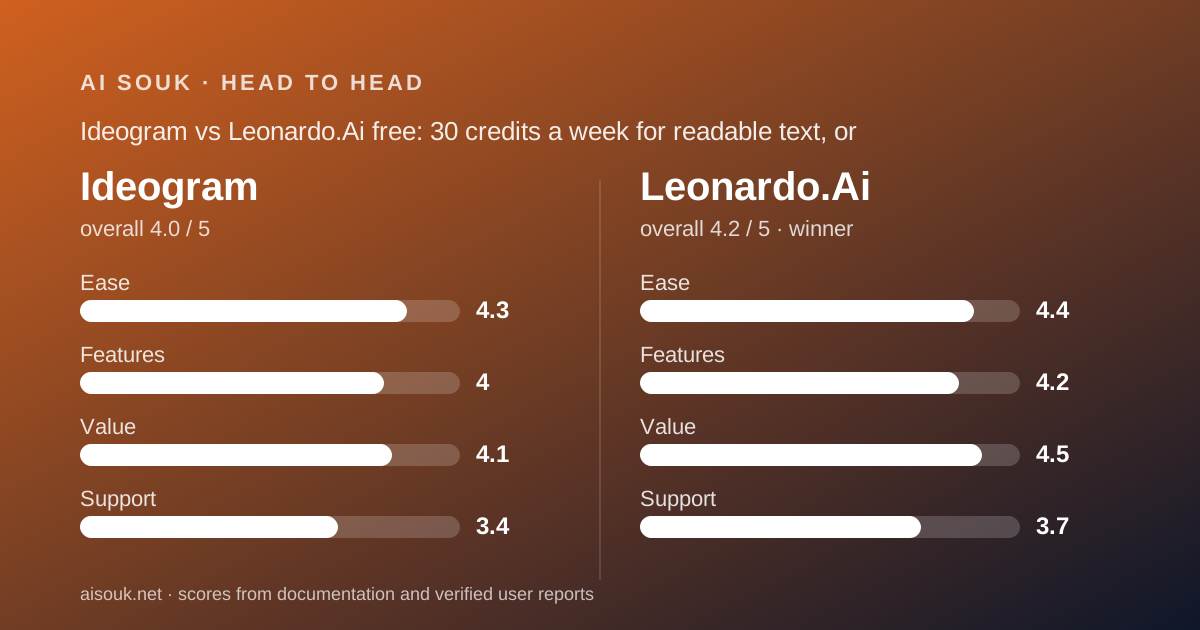
Both image generators give you a public gallery and a free allowance, and that is where the similarity ends. Ideogram's free plan is 30 credits a week, only if you sign in with Google, Apple or Microsoft, with text-in-image as its documented specialty. Leonardo.Ai's free plan is 150 fast tokens a day with a published cost table, commercial use permitted, and a broad licence over anything you leave public. Short answer: Leonardo for most small businesses that generate images regularly; Ideogram when the image must contain words you can read. Figures come from the vendors' documentation as of October 2026.
 4.0Ideogram
 4.2Leonardo.Ai
The short answer
This is a documentation comparison. It uses Ideogram's documentation at docs.ideogram.ai, its Plans and Credits page and FAQ, and Leonardo.Ai's pricing page and help centre, all checked October 7, 2026. Ideogram's public pricing page was not retrievable, so its documentation is the source of record. No account was opened and no image was generated for this page. The single-product pages are Ideogram and Leonardo.Ai.
Leonardo wins for a business that generates images as a routine, on three documented grounds. Its free budget is larger and daily, 150 tokens every 24 hours against 30 credits a week. Its costs are published, a default image at one token, an upscale at five, Alchemy modes at eight to sixteen, so the budget can be planned; Ideogram sends users to a usage-cost view inside settings and does not publish the per-image cost. And its help centre states that commercial use of generated images is permitted for free users too; Ideogram refers that question to its Terms of Service.
Ideogram wins the case its documentation is built around: images with readable text, posters, social cards, signs, logo concepts, which is the single most common way small-business image generation fails elsewhere. If that is the job, 30 weekly credits of the right tool beats 150 daily tokens of the wrong one. Both free plans make everything public, and neither lets a free user make an image private after the fact, so the privacy section applies equally.
What each free tier includes (as of October 2026)
Ideogram's Plans and Credits page states, in one precise sentence, that free accounts get 30 credits each week if they sign in with Google, Apple or Microsoft, and that accounts created with an email address and password receive no free credits at all. The documentation states, on two pages in the same words, that on the free plan and the legacy Basic plan everything you generate is public, and that unpublishing requires a plan with private generation. Output on free is JPEG at original size, or transparent PNG at 1K resolution; PNG download and upscaling require a paid plan. The feature set described, prompt-to-image, text rendering, Remix, Describe, reference images, Studio editing, transparent backgrounds, is not marked paid-only, but the FAQ says reference images and edits always cost credits and the per-operation cost is not on the plans page.
Leonardo's pricing page lists the free plan at $0 with: Fast Tokens 150 per day; Token Bank 150; Creations access Public; Presets included; Quality settings Basic; Personal collections 1. The help centre's token FAQ says the 150-token allowance resets every 24 hours and that unused tokens expire rather than carry over. Its token-usage article prices a default 768x768 image at one token, four images at four, background removal at two per image, an upscale at five, Alchemy at eight (sixteen with the prompt-magic option), Alchemy V2 on Lightning XL at ten, and 3D texture generation at thirty, with the cost shown on the generate button before you commit. The help centre's private-and-public article says private generation is only available to paid members. Top-up tokens are listed as a paid-plan feature.
On paper, then: Leonardo's free day is up to 150 plain images or around nine heavier Alchemy ones, at Basic quality; Ideogram's free week is 30 credits of operations whose unit cost the vendor does not publish. Leonardo's allowance exists for every account; Ideogram's depends on the sign-in button you press on day one.
Daily limits and what happens when you hit them
Leonardo's wall is daily and absolute. When a free user runs out, the help centre says they wait for the next daily reset, with the time shown by hovering over the token counter. There is no slow queue on free, no top-up purchase on free, and no carry-over: the allowance rewards a daily habit and penalises batch use. Because the premium modes cost a large fraction of the day, Alchemy at sixteen tokens means nine images, a 3D texture at thirty means five, public forum reports of running out quickly almost always involve a user who did not read the cost on the button. The help centre also carries a separate daily-allowance article for one third-party model, which suggests some models have caps on top of the plan allowance.
Ideogram's wall is weekly and has one documented side door. The FAQ states that free and pay-as-you-go accounts require credits for every generation, so a free user who spends the week's 30 by Tuesday waits for the reset; the slow queue that lets Plus, Pro and Team subscribers keep generating after credits run out is a paid feature in its documented form. The side door is purchase: extra credits are priced at one US cent each, in preset amounts or any amount from $1 to $300, last 365 days, and are available to accounts without a subscription per the extra-credits page. So a free Ideogram user can buy a few dollars of retries; a free Leonardo user cannot buy anything without upgrading. Credits on both do not roll over on paid plans, and Ideogram's documentation states it does not offer refunds.
The practical difference: Leonardo's limit is generous and strict; Ideogram's is tight and porous. A business that needs one more image today can get it from Ideogram for a cent a credit and cannot get it from Leonardo until tomorrow.
Quality of output for everyday work
Image quality cannot be graded from documentation, and this page will not. What the documents support is a statement about what each is built for and what each free tier lets you do with the result.
Ideogram's documented specialty is text inside images, and the documentation covers Remix, Describe, which turns an image into a reusable prompt, reference images, transparent backgrounds, batch runs from a spreadsheet and custom model training. Public reports, consistent with the documentation and not verified here, say text rendering is strong but not perfect on long strings or unusual fonts, so a second or third attempt is common, and at 30 credits a week retries are the scarce resource. Free output is JPEG at original size with no upscaling, which is adequate for a social post and not for print.
Leonardo's documented range is broader: a model line that the pricing page names, Lucid Origin, Lucid Realism, Phoenix, Flux variants, plus video models on the higher tiers, preset styles, Alchemy processing, background removal, upscaling at five tokens and 3D texture generation. Free quality settings are listed as Basic against Enhanced on paid plans, which is the vendor's own statement that free output is a lower setting of the same engine. Upscaling is available on free within the token budget, which Ideogram gates behind a paid plan.
For everyday small-business use, a product shot concept, a blog cover, a lifestyle scene, Leonardo's free plan reaches further because it can upscale and because the budget allows iteration. For a flyer with a headline on it, Ideogram's free plan is the tool, and the JPEG limit is the cost of using it for nothing. Keep in mind this site's own rule that AI images are for concepts and lifestyle, not for depicting a specific product you sell.
Privacy and training defaults
For both products the first privacy fact is visibility rather than training: on the free plan, every image you generate is public, with its prompt, and a free user cannot make it private afterwards. Ideogram's documentation states it in the same words on two pages; Leonardo's help centre says private generation is a paid feature and that public images can be viewed and remixed by other users. Decide first whether that is acceptable for what you intend to generate.
The second fact is licence, and here Leonardo's documentation is explicit in a way that should be read twice. Its private-and-public article states that images not set to private grant the vendor rights to use, copy, reproduce, adapt, modify, publish, create derivative works of, publicly display, sublicense and distribute them; the FAQ adds that paid subscribers own all rights in the outputs generated. So on free, every image is public, remixable and licensed to the vendor; on paid with Private Mode, it is yours. Ideogram's documentation refers rights and commercial use to its Terms of Service and says users bear responsibility for ensuring content complies with laws and platform terms; this page has not summarised those Terms.
The third fact is the one neither free plan answers on the pages checked: whether prompts and uploaded reference images are used to train or improve models, and how long uploads are retained. Both are questions for the current privacy policy at your tier.
The rule that follows from all three is the same for both: do not upload a client's logo, an unreleased product photo or a colleague's face to a free tier whose output is public and, on Leonardo, licensed. For commercial reference material, the paid tier with private generation is the entry point, not an upgrade.
Price of the first paid step
Ideogram Plus is $20 a month, or $15 a month billed annually at $180 a year, with 2,400 credits a month, per the plans page. It changes three things in kind: new images stay private until published, generation continues after credits run out in a slower queue with no limit, and PNG download and upscaling unlock. Pro is $60 a month or $42 annually with 7,500 credits; Team is $30 per user monthly or $20 annually with 3,600 credits per user. Credits do not roll over, and extra credits at a cent each are available to anyone.
Leonardo Essential is $12 a month ex-tax, with up to 20 percent off annually, for 8,500 fast tokens a month, a Token Bank of 25,500, private creations, Enhanced quality, unlimited collections, 10 personal AI models, two simultaneous generations and the ability to buy top-ups. Premium is $30 for 25,000 tokens and unlimited relaxed image generation on selected models; Ultimate is $60 for 60,000 tokens and relaxed video as well. The Token Bank stores unused tokens up to three months on paid plans, which turns a daily budget into a quarterly one. Canva's October 2025 newsroom post states that Canva Business includes the Leonardo Essential plan; check whether you already have it.
So the first paid step is $12 on Leonardo against $15 on Ideogram on annual terms, and both buy the same two things that matter, privacy and more volume, with Ideogram adding the no-limit slow queue and Leonardo adding the rollover bank and Enhanced quality. For a business, the realistic reading is that the paid tier is where either product starts, because it is where the images stop being public. Prices on both pages are stated as subject to change; Leonardo's are ex-tax; read the current pages.
Pick this one if…
Pick Ideogram if the image must contain words. A sale banner, a quote card, a sign, a logo concept: text rendering is the documented specialty and the reason to accept a smaller allowance.
Pick Leonardo if you generate images most days and want a budget you can plan. One hundred and fifty tokens every 24 hours with a published cost table is the most generous free allowance in this site's image batch.
Pick Leonardo if commercial use on the free plan matters to you and you want it stated. The help centre says it is permitted for free users; Ideogram refers you to its Terms.
Pick Ideogram if you need an occasional extra without a subscription. Credits at a cent each from $1 upward, valid a year, is a route Leonardo's free plan does not have.
Pick neither free plan for anything you would not want in a public gallery with its prompt attached. That is both vendors' documented rule, and it is the reason the paid tier is the real entry point for client work.
Frequently asked
Why does Ideogram give some free accounts no credits? Because its plans page ties the 30 weekly credits to signing in with Google, Apple or Microsoft, and states that email-and-password accounts receive none. It is unusual, it catches people out on public forums, and it is the first thing to know before creating an account.
How many images is 30 Ideogram credits? This page cannot say, because the vendor does not publish the per-operation cost on its plans page; it sends users to a usage-cost view in their own settings. The FAQ's note that reference images and edits always cost credits suggests the plain generation is the cheap operation. Leonardo, by contrast, publishes the table: one token for a default image, which is why its budget can be stated as a number of images and Ideogram's cannot.
Is there an option that keeps images private for free? Not between these two. For a business whose question is where the training data came from rather than who can see the output, Adobe Firefly documents its training sources and Content Credentials and offers daily free generations without a public gallery requirement; and Canva Magic Studio puts a small monthly AI allowance inside an editor many small businesses already use.
Visit Ideogram
We have no affiliate relationship with this vendor. Link goes to the official site.
Visit Leonardo.Ai
We have no affiliate relationship with this vendor. Link goes to the official site.