 AI
AI
Leonardo.Ai
A daily token allowance that resets every 24 hours - the most usable free image budget in this batch, as long as public is acceptable.
Scored on the published rubric, from documentation, pricing and verified user reports.
Best for: A solo creator or small business that wants to generate a steady trickle of images every day for nothing, understands the token cost table, and does not mind the results being visible to other users.
Verdict
This is a documentation review, not a walkthrough: no account was opened for this page and no screenshots were captured, so nothing here is a first-hand claim about what the interface looks like today. On the documented design, Leonardo.Ai has the most practically useful free allowance of the image generators reviewed in this batch, for a structural reason: it is daily rather than weekly or monthly. Per the pricing page (checked October 7, 2026), the free plan gives 150 fast tokens a day, and per the help centre a default image costs one token, so the arithmetic is unusually favourable even after allowing for the pricier modes. The two documented conditions are the same ones that govern the category: free generations are public, and tokens that go unused at the end of the day are gone. The help centre also states, in plain words, that commercial use is permitted for free users, which is a clearer answer than most competitors give. The paid tiers buy privacy, a token bank that rolls over, and on the higher plans unlimited relaxed generation on selected models.
Visit Leonardo.Ai
We have no affiliate relationship with this vendor. Link goes to the official site.
Where it is strong
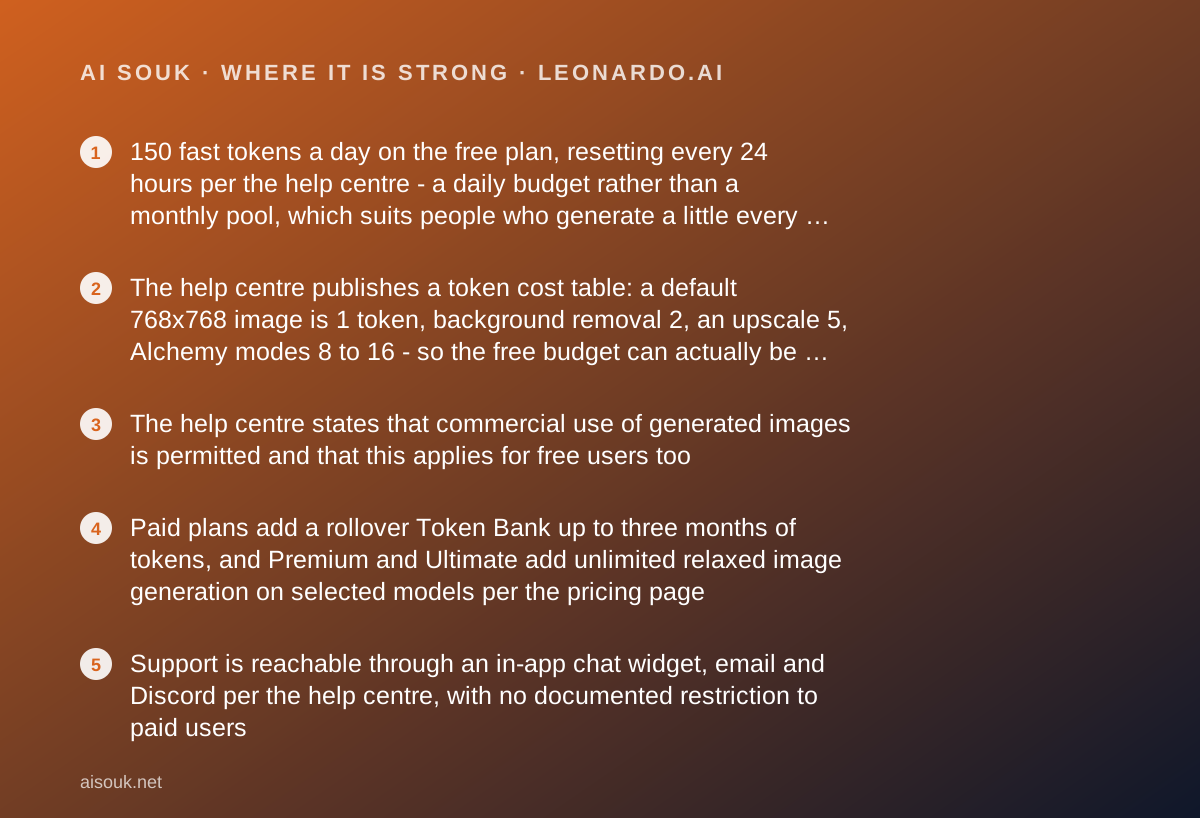
- 150 fast tokens a day on the free plan, resetting every 24 hours per the help centre - a daily budget rather than a monthly pool, which suits people who generate a little every day
- The help centre publishes a token cost table: a default 768x768 image is 1 token, background removal 2, an upscale 5, Alchemy modes 8 to 16 - so the free budget can actually be planned
- The help centre states that commercial use of generated images is permitted and that this applies for free users too
- Paid plans add a rollover Token Bank up to three months of tokens, and Premium and Ultimate add unlimited relaxed image generation on selected models per the pricing page
- Support is reachable through an in-app chat widget, email and Discord per the help centre, with no documented restriction to paid users
Where it falls short
- Free generations are public: the help centre says private image generation is a feature only available to paid members, and public images can be viewed and remixed by other users
- Public images grant the vendor a broad licence - the help centre lists rights to use, reproduce, adapt, publish and create derivative works - which a business should read before uploading reference material
- Unused daily tokens expire and do not carry over on the free plan, per the help centre, so the allowance rewards daily habit and penalises batch use
- Free quality settings are listed as Basic on the pricing page versus Enhanced on paid plans, and the higher-cost modes like Alchemy consume a large fraction of a day's tokens per image
- The plan names on the pricing page (Essential, Premium, Ultimate) differ from the names used in many third-party guides, which makes external advice hard to map to the current tiers
What the free tier actually includes
Figures in this section come from the Leonardo.Ai pricing page and the vendor's help centre, both checked October 7, 2026. Prices on the pricing page are stated ex-tax.
The free plan is listed at $0 a month with the following line items: Fast Tokens 150 per day; Token Bank 150; Creations access Public; Presets included; Quality settings Basic; Personal collections 1. The help centre's token FAQ says the same thing in prose: as a free user you have a daily allowance of 150 tokens, the allowance resets every 24 hours, and tokens do not accumulate if unused - they expire and do not carry over to the next day. When a free user runs out, the help centre says they wait for the next daily reset; hovering over the token counter shows when that is.
What a token buys is also documented, which is rarer than it should be. The help centre's token usage article prices a default 768x768 image at 1 token, four of them at 4 tokens, background removal at 2 tokens per image, an upscale at 5 tokens, and the premium processing modes much higher: Alchemy at 8 tokens per image with a prompt-magic option off and 16 with it on, Alchemy V2 on Lightning XL models at 10, full 3D texture generation at 30. Using several reference images for guidance adds cost - the article gives 7 tokens for a four-reference premium example. The help centre notes that the cost is shown on the generate button before you commit, which is the number to trust over anything written here.
So the free day is, in the documented arithmetic, up to 150 plain images or around nine heavier Alchemy images - the most generous free budget in this batch, with the reminder that the quality setting on Free is Basic.
The condition is visibility. The pricing page lists Creations access as Public on Free and Private on every paid plan; the help centre says private image generation is a feature only available to paid members. More on that in the privacy section, because it is the fact that decides whether the free plan is usable for your purpose.
- 150 fast tokens per day, reset every 24 hours, no carry-over on Free (pricing page and help centre, October 2026)
- Documented token costs: default image 1, background removal 2, upscale 5, Alchemy 8 to 16, 3D texture 30
- Creations public on Free; Basic quality setting; one personal collection
What sits behind the paywall
The pricing page lists three solo paid tiers, all ex-tax and with up to 20 percent off for annual billing. Essential is $12 a month: 8,500 fast tokens a month, a Token Bank of 25,500, private creations, Enhanced quality, unlimited personal collections, 10 personal AI models, 2 simultaneous generations and the ability to buy top-up tokens. Premium is $30 a month: 25,000 tokens, a 75,000 bank, 20 personal models, 3 simultaneous generations, a queue of 10, and unlimited image generation at a relaxed pace on selected models. Ultimate is $60 a month: 60,000 tokens, a 180,000 bank, 50 personal models, 6 simultaneous generations, a queue of 20, and unlimited relaxed generation for both images and video on selected models.
The Token Bank is the feature that changes the economics. Per the help centre's rollover article, the bank stores unused tokens on paid plans with an active subscription and accumulates up to three months worth; the bank capacities on the pricing page are exactly three times the monthly allowance. Free users have no rollover. So the paid plans turn a use-it-or-lose-it daily budget into a quarterly one.
The unlimited relaxed generation on Premium and Ultimate is bounded by a footnote worth reading in full on the pricing page. It applies only to selected models - the page lists, as of October 2026, Lucid Origin, Lucid Realism, Phoenix 1.0 and 0.9, Flux Dev, Flux Schnell and the preset styles for images, and Hailuo 2.3, Hailuo 2.3 Fast, Wan 2.6, Motion 2.0 and Motion 2.0 Fast for video - and the page says concurrency and queuing of unlimited generations may be slowed based on demand. It is unlimited in count, not in speed, and not across every model.
One cross-reference: Canva's October 2025 newsroom post announcing Canva Business states that Business subscribers receive the Leonardo.Ai Essential plan as an inclusion. If you already pay for Canva Business, check whether you have this before buying it separately.
Who it is for, and who should skip it
The free plan fits a specific habit: generating a few images most days rather than a hundred on the last Friday of the month. A daily budget that expires at midnight is, by design, hostile to batch work and friendly to routine. A small business posting daily social content, a hobbyist iterating on a style, a writer who wants a cover concept a day - these people can live inside 150 tokens indefinitely, and at one token per default image they will rarely hit the ceiling unless they lean on Alchemy or upscaling.
It also fits anyone who wants a clear answer on commercial rights without a lawyer. The help centre's FAQ says: yes, you can use the images you generate on the platform for commercial purposes, and this applies for free users too. The commercial usage article adds the qualifier that matters - on the free plan those designs will also be publicly viewable for other Leonardo users to copy and remix. Commercial use is allowed; exclusivity is not.
Who should skip the free plan: anyone generating for a client, for an unreleased product, or from a reference image they do not want circulating. The visibility rule and the licence attached to public images, both quoted in the privacy section, make Essential at $12 a month the honest entry point for that work. That is the same shape as the Ideogram free tier and the same advice.
Who should skip the product: anyone who mainly needs layout, where the Canva Magic Studio page is the relevant one; anyone whose images must carry exact text, where Ideogram's documented specialty is the better fit; and anyone for whom the provenance of training data is the deciding question, where Adobe Firefly makes specific claims that this vendor's documentation does not.
Limits and what users report
The limits divide into the ones the vendor publishes and the ones that follow from them.
Published: 150 tokens a day on Free, no carry-over, public creations, Basic quality, one collection, no personal AI models, no top-ups. The pricing page lists top-up tokens as a feature of paid plans only, which means a free user who exhausts the day cannot buy their way out of it; they wait. Simultaneous generations are not listed for Free at all, which this page reads as a single generation at a time but cannot confirm.
Following from them: the premium modes are expensive relative to the daily budget. At 16 tokens an image for Alchemy with the heavier option, nine images a day is the ceiling; at 30 tokens a 3D texture job, five. The help centre says the cost is displayed before generating, and the practical discipline for a free user is to read it every time.
On public forums, consistent with the documentation and not independently verified here, the recurring reports are three. Users describe running out of tokens quickly when using Alchemy or upscaling without noticing the per-image cost, which the cost table predicts. Users describe surprise at finding their generations in the community feed, which the visibility rule predicts. And users note that the plan names have changed - older guides refer to Apprentice, Artisan and Maestro tiers, while the pricing page in October 2026 lists Essential, Premium and Ultimate - which makes older advice about token counts unreliable. The help centre also carries a separate daily-allowance article for one third-party model, which suggests some models have their own caps on top of the plan allowance; check the model you intend to use.
Privacy and data use
The documentation is more specific here than most, and the specifics are the reason to read it.
Visibility first. The help centre's private-and-public article says private image generation is a feature only available to paid members, that images generated with the Private Mode toggle off or manually marked as public will be visible and usable by other members, and that toggling Private Mode off makes images visible to the public feed. Free users do not have the toggle.
Licence second, and this is the part a business should read twice. The same article states that images not set to private grant the vendor rights to use, copy, reproduce, process, adapt, modify, publish, transmit, create derivative works of, publicly display, publicly perform, sublicense and distribute them, and to make them available to the public. The FAQ adds that paid subscribers own all rights, titles and interests in the outputs generated. So on the free plan, every image is public, other users may remix it, and the vendor holds a broad licence over it; on a paid plan with Private Mode, the output is yours. That is a clear and documented difference, and it should be the deciding factor for any commercial reference material.
Still to check in the current privacy policy: whether prompts and uploaded reference images are used to improve the vendor's models and whether that differs by tier, how long uploads are retained, and - since the vendor is a Canva company - which policy governs an account that arrives through a Canva Business bundle.
Do not upload a client's product photo, a colleague's face or an unreleased design to a free tier where the output is public and licensed. This page cannot verify current policy wording. Read it for your tier.
Alternatives worth a look
The three nearest alternatives are all reviewed on this site, and the comparison is mostly about which free-tier condition you can live with.
Ideogram has the same public-on-free rule and a weekly rather than daily allowance - 30 credits a week, only with Google, Apple or Microsoft sign-in - which is a smaller budget in raw count. Its documented advantage is rendering legible text inside images, which Leonardo's documentation does not lead with. If the words in the image matter, go there; if daily volume matters, stay here.
Adobe Firefly describes its free plan as limited daily generations across image, video and audio, refreshing every day, and does not publish the count. Where Firefly differs in kind is provenance: Adobe states that its own models are trained on licensed Adobe Stock and public-domain content and that it does not train on subscribers' personal content. Leonardo's help centre makes clear statements about commercial use and about the licence on public images, but the documentation reviewed does not make an equivalent training-data claim. For a business whose first question is legal exposure, that is the difference.
Canva Magic Studio is the design editor that, per Canva's own newsroom, bundles Leonardo's Essential plan into Canva Business; if you would otherwise buy both, check that bundle first. For the research step before generating, Perplexity is the better tool.
Frequently asked
How many free images a day? The pricing page says 150 fast tokens a day and the help centre prices a default 768x768 image at 1 token, so up to 150 plain images in the documented arithmetic. Heavier modes cost 8 to 30 tokens each and reduce that sharply. The cost shows on the generate button.
Do unused tokens carry over? Not on Free. The help centre says they expire at the daily reset. Paid plans have a Token Bank that holds up to three months of tokens.
Are my free images private? No. The help centre says private generation is only available to paid members, and public images can be viewed and remixed by other users.
Can I use free images commercially? The help centre says yes, and that this applies to free users too, with the caveat that free images are public and others can copy and remix them.
What does Enhanced quality mean? The pricing page labels Free as Basic and paid as Enhanced and does not define the difference. This page does not guess.
What changed in the plan names? As of October 2026 the pricing page lists Essential, Premium and Ultimate. Older third-party guides use different names; treat their token figures as out of date.
Why no screenshots? Because none were captured for this page. That is what a documentation review means here.
Does this page earn a commission? No. There is no affiliate relationship with this vendor; the link goes to the official site.
Bottom line
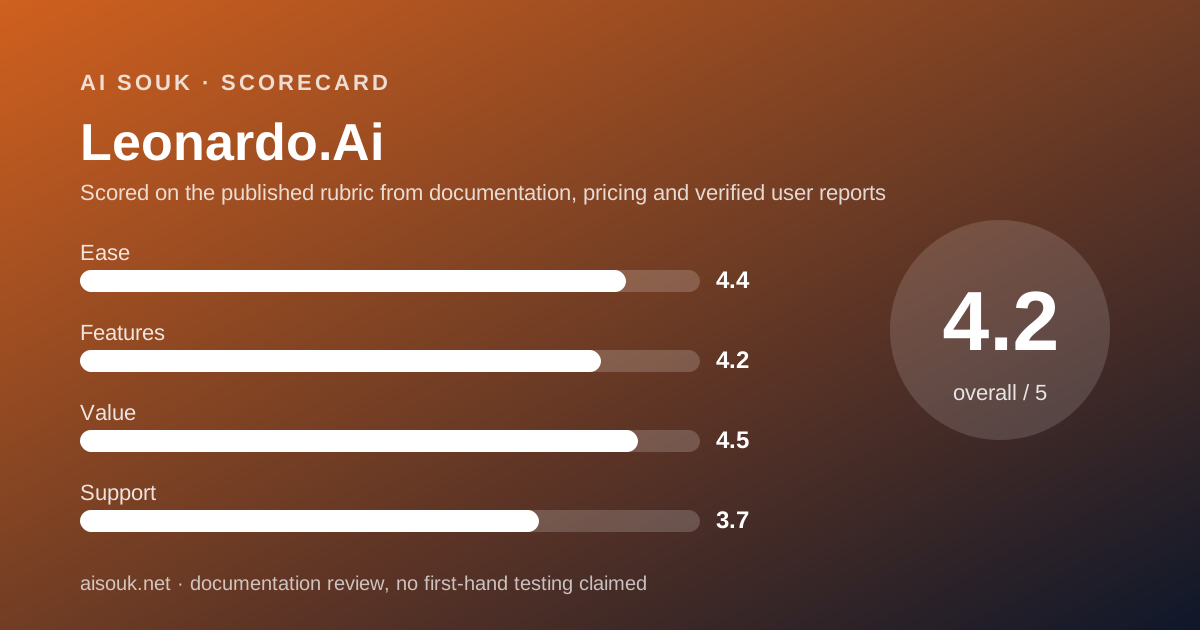
On the documented design, Leonardo.Ai's free plan is the one in this batch most likely to be enough on its own, because the allowance is daily, the cost of a plain image is one token, and the help centre says what every operation costs before you press the button. The value score is the highest of the four sub-scores for that reason: a free user who generates a little every day may never need to pay, and a paid user at $12 a month gets privacy, Enhanced quality and a bank that stops the clock on unused tokens. The features score reflects a wide documented set - reference images, personal models, 3D texture, video and motion on higher tiers, unlimited relaxed generation on selected models - with the honest deduction that the expensive modes eat the free budget fast. Ease is high because the sign-up conditions are ordinary and the free allowance is a stated number. Support is a little above the category norm because the help centre documents three contact channels with no paid-only restriction.
The condition is the same one that governs every free image generator worth using: public output, with a broad licence attached. Use the free plan for anything you would be happy to see in a community feed, and move to Essential the day you generate something for a client.
What this page cannot tell you, stated plainly because the site's method requires it: what the interface looks like today, which models are available on Free this week, what Enhanced quality looks like next to Basic, or whether the plan names and token counts on the pricing page have changed again. No account was opened and no screenshots were captured. Those facts live on the vendor's pricing page and help centre, and they change more often than this review will.
Visit Leonardo.Ai
We have no affiliate relationship with this vendor. Link goes to the official site.