 AI
AI
ElevenLabs
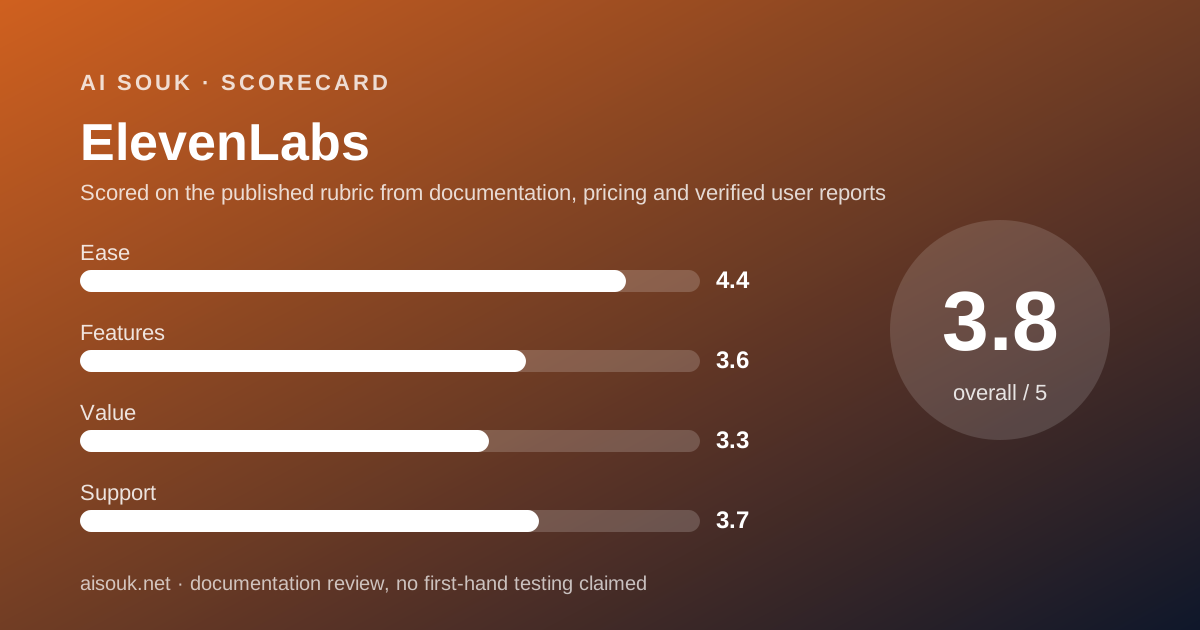
The most-cited AI voice platform, with a free tier that lets you hear the quality but not sell anything made with it.
Scored on the published rubric, from documentation, pricing and verified user reports.
Best for: Anyone who needs to judge whether synthetic narration is good enough for their project before paying, and who can live with a strictly non-commercial free tier while they decide.
Verdict
This is a documentation review, not a walkthrough: no account was opened for this page and no screenshots were captured, so nothing here is a first-hand claim about what the interface looks like today. On the documented design, ElevenLabs is a broad audio platform rather than a single text-to-speech tool: the pricing page (checked October 7, 2026) lists text to speech, speech to text, sound effects, voice design, music and a studio for longer productions, and the free tier reaches all of them with a 10,000-credit monthly allowance. The catch is the license. The terms of use say free users may only use the service for non-commercial purposes, and the pricing page lists no commercial license and no voice cloning on the free plan. So the free tier is an honest evaluation tier: enough to learn whether the voices suit your material, not enough to ship a product with. The value score is held down because the thing a small business actually needs, the right to use the audio commercially, starts at the first paid tier, and the tier structure with promotional first-month prices changes often enough that the current figures must be read from the vendor.
Visit ElevenLabs
We have no affiliate relationship with this vendor. Link goes to the official site.
Where it is strong
- The free tier covers the whole product surface - text to speech, speech to text, sound effects, voice design, music and three studio projects - rather than a single demo feature, per the pricing page
- Credit accounting is published and simple for the main case: on the V2 multilingual models, one text character costs one credit, so 10,000 credits is roughly 10,000 characters of narration a month
- The documentation states that identical regenerations are free up to two times, which protects a small allowance from being burned by retries
- Published per-plan concurrency limits and model character caps make it possible to plan a workload from the documentation alone
- The terms are plain about the free-user restriction, so there is no ambiguity to discover after the fact
Where it falls short
- No commercial license on the free plan: the terms of use restrict free users to non-commercial purposes, which rules out client work, monetised videos and product voiceovers until you pay
- Voice cloning is absent from the free plan and the voice library is not available through the API to free-tier users, per the documentation, so the two features people most often want to try are the two withheld
- Unused credits do not roll over on the free plan; the rollover described on the pricing page applies to paid subscriptions
- Non-text products are far more expensive per minute - the pricing page lists speech to text at 330 credits a minute and music at 900 - so 10,000 credits disappears quickly outside plain narration
- The entry tiers are shown with promotional first-month prices that differ from the ongoing price, which makes the real monthly cost harder to read than it should be
What the free tier actually includes
According to the pricing page, checked October 7, 2026, the Free plan is $0 and includes 10,000 credits per month. The credit is the unit for everything, and the FAQ on the same page explains the conversion for the main case: for the V2 multilingual text-to-speech models, one text character equals one credit. In plain terms, the free plan buys about 10,000 characters of narration a month on those models, which is somewhere around fifteen hundred words of finished script, or a handful of short voiceovers.
The free plan reaches most of the product surface. The pricing page lists text to speech, speech to text, sound effects, voice design, music, image generation and a studio for longer productions, with a cap of 3 projects in the studio. It also lists 2 custom voices and a concurrency allowance in the region of 10 simultaneous requests.
Two items are explicitly absent from the free column. There is no commercial license, and there is no voice cloning of any kind. The product documentation adds a third restriction worth knowing: the voice library is not available via the API to free-tier users, so a developer evaluating the API on the free plan will not be able to pull voices from the shared library programmatically.
One helpful documented rule softens the small allowance. The text-to-speech documentation states that a user can regenerate the same content up to two times at no additional cost, provided nothing about the text or settings has changed. Retries to get a cleaner take do not have to eat credits.
The pricing FAQ also notes that credits on paid plans roll over for up to two months; that rollover does not apply to the free plan, so an unused allowance simply resets.
- 10,000 credits per month; 1 credit per character on V2 multilingual text to speech (pricing page, October 7, 2026)
- Text to speech, speech to text, sound effects, voice design, music, image, and 3 studio projects
- 2 custom voices; roughly 10 concurrent requests
- No commercial license, no voice cloning, no API access to the voice library
- Identical regenerations free up to two times, per the documentation
What sits behind the paywall
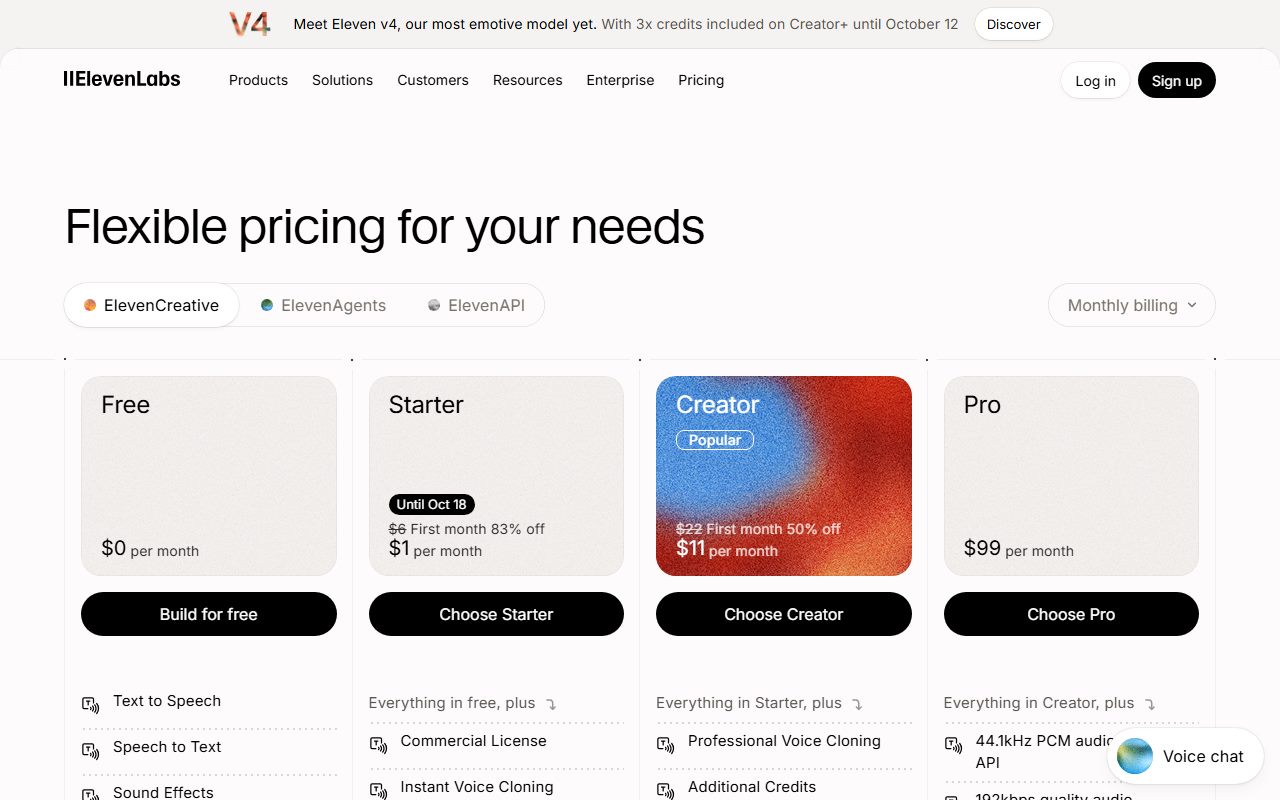
The thing that moves first when you pay is the license, not the quality. The pricing page's Starter plan is described as everything in Free plus a commercial license, instant voice cloning, 20 studio projects, commercial use of generated music, a dubbing studio and image and video tools, with 30,000 credits a month. Creator adds professional voice cloning and raises the allowance to 121,000 credits. Pro is listed at $99 a month, Scale at $299, Business at $990, and Enterprise is custom.
The Starter and Creator prices are the part this page will not quote as a single number, because the pricing page, as read on October 7, 2026, shows them with a promotional first-month price and a different ongoing figure, and the wording of that promotion is the kind of thing that changes between visits. Read the current page and check whether the price you are looking at is the first month or every month.
The second thing the paywall controls is cost per minute outside narration. The FAQ lists speech to text at 330 credits per minute, music at 900 credits per minute and dubbing between 2,000 and 10,000 credits per minute depending on type. At those rates the free plan's 10,000 credits is roughly thirty minutes of transcription or eleven minutes of music, before any narration. If your interest is dubbing or music rather than voiceover, the free tier is a taster rather than a working allowance.
The third thing is audio quality options. The documentation says higher-quality audio formats are only available on paid tiers. The free tier is enough to judge the voice; it is not necessarily the output format you would ship.
As always on this site, the advice is to read the pricing page yourself before deciding. The tier names have stayed stable; the numbers inside them have not.
Who it is for, and who should skip it
The free tier suits one person very well: someone deciding whether AI narration is good enough for a specific use, who wants to hear the actual models on their actual script before committing money. Ten thousand characters is enough to voice a few representative paragraphs in several voices and languages and reach a judgement. It is also enough for a developer to confirm the API works and understand the request shape, provided they do not need the shared voice library.
It suits hobby use within the non-commercial boundary: a personal project, a study aid, an accessibility experiment, a prototype that will never be published for money.
It does not suit anyone who intends to use the output in a business context, because the terms of use are explicit. The vendor's terms state that a user who accesses the services free of charge may only use them for non-commercial purposes, and add that a personal email address must be used for non-commercial use. A small business voicing a product video, a freelancer delivering a client's explainer, a podcaster running ads: all of these are commercial, and all of them need the first paid tier at minimum. There is no grey zone to argue about.
It also does not suit anyone whose main interest is cloning their own voice, since no cloning exists on the free plan, or anyone whose workload is transcription, music or dubbing at volume, since those are priced per minute at rates that exhaust the free allowance fast.
The honest framing is that this is an evaluation tier with a hard legal boundary. For evaluation it is generous. For work it is not meant to be used at all.
Limits and what users report
The limits that matter are published, which is to this vendor's credit. The text-to-speech documentation lists per-request character caps by model: 10,000 characters for the Eleven v4 and Multilingual v2 models, 5,000 for Eleven v3 and 40,000 for Flash v2.5. A long script has to be split, and a free user is working inside a monthly allowance that equals exactly one maximum-length request on the flagship models.
The pricing page lists concurrency by plan, with the free tier at roughly 10 simultaneous requests. That is more than a free user is likely to need, and it is one of the few places where the free tier is not meaningfully throttled.
The documentation is open about model economics: Flash v2.5 is described as half the price per character for API generations compared to the higher-quality models. A free user who wants to stretch the allowance can use the cheaper model for drafts and reserve the expensive one for final takes, which is a reasonable workflow the documentation itself implies.
What users on public forums most often report, in a pattern consistent with the documentation, is surprise at how quickly credits go. The reason is usually one of two things: counting the allowance in words rather than characters, or trying a non-text product like music or dubbing without reading the per-minute rates. Both are avoidable by reading the FAQ once.
This page cannot verify today's limits. The pricing page can.
Privacy and data use
Three questions to answer from the vendor's own policy rather than from any review, and they are slightly different for a voice product than for a text one.
First, whether what you type and upload is used to improve the models, and whether that differs by tier. This is normally stated in the privacy policy and sometimes in a settings page, and the answer for free tiers is often different from the answer for business tiers.
Second, what happens to audio you upload. Speech to text and voice cloning both involve giving the vendor recordings, and recordings of a person's voice are a more sensitive category than text in most jurisdictions. The free tier does not include cloning, so a free user is only exposed through uploads for transcription, but the question still applies.
Third, and specific to this category, consent and identity. The vendor's terms and prohibited-use policy apply to free users in full, and the central rule across this category is that you may only clone or imitate a voice you have the right to use. A small business that wants to voice a founder's message should read that section before uploading anything, and a business that wants to use a voice resembling a public figure should not.
The general rule that applies whatever the policy says this month: a script pasted into a consumer AI tool has left your building. Unreleased announcements, client material and anything under a confidentiality obligation belong on a plan whose data terms you have read and agreed to, not on a personal-email free account.
This page is a documentation review and cannot confirm current policy wording. Read the policy for the tier you are on.
Alternatives worth a look
The right alternative depends on which part of the audio job you actually have.
If the task is music rather than speech, Suno is the dedicated option, with a free tier built around a daily credit allowance and the same basic shape of restriction: free output is personal and non-commercial, and commercial rights start with the paid plans. The two products overlap only at the edges, since ElevenLabs lists music as one product among many and Suno does nothing else.
If the task is editing spoken recordings - podcasts, interviews, screen recordings - rather than generating speech from scratch, Descript approaches the problem from the editor's side: it transcribes the recording and lets you cut the audio by editing the text, with its own voice and audio-cleanup tools included on a credit system. For someone whose raw material is a human voice, that is often the more useful shape.
If the task is research that happens to involve audio, such as turning a pile of documents into a spoken summary, NotebookLM generates audio overviews grounded in sources you upload, and its free tier is unusually substantial because the grounding behaviour is the free behaviour.
None of these replaces ElevenLabs for the core case of high-quality narration from a script in many languages. They are listed because the free tier here is strictly non-commercial, and a reader whose real need is commercial should know what else exists before concluding they must pay.
Frequently asked
Can I use free-tier audio in a YouTube video or a client project? Not for anything commercial. The terms of use restrict free users to non-commercial purposes, and the pricing page lists no commercial license on the free plan. A monetised channel or paid client work needs at least the first paid tier.
How much narration is 10,000 credits? On the V2 multilingual models, the pricing FAQ states one character equals one credit, so about 10,000 characters a month. That is roughly fifteen hundred to two thousand words depending on the language and punctuation, as of October 2026.
Can I clone my voice on the free plan? No. Voice cloning is listed only from the first paid tier, with professional cloning higher up.
Do free credits roll over? No. The pricing page describes rollover for paid subscriptions only.
Can I use the API for free? The documentation refers to free-tier API users, so API access exists, but it states the voice library is not available via the API on the free tier. Check the current API documentation for today's rate and model limits.
Why no screenshots on this page? Because no account was opened for it. That is what a documentation review means on this site, and the method page explains the distinction.
Does this page earn a commission? No. There is no affiliate relationship with this vendor; the link goes to the official site.
Bottom line
On the documented design, ElevenLabs offers one of the broadest free tiers in AI audio and one of the most clearly fenced. The breadth is real: text to speech, speech to text, sound effects, voice design, music and a studio, all reachable without paying, with a published credit system that makes the main case easy to budget. The fence is also real: the terms of use say free users may only use the service for non-commercial purposes, and the features most people want to test second, cloning and the voice library over the API, are withheld.
Use the free tier for what it is good at. Paste your real script, try several voices and languages, use the free regenerations, and decide whether the output meets your standard. That decision is the valuable one and it costs nothing.
Then, if the answer is yes and the use is commercial, read the current pricing page carefully, including the difference between a promotional first-month price and the ongoing one, and buy the tier whose license and credit volume match your work. Do not ship free-tier audio in anything that earns money; the terms are not ambiguous and the risk is yours.
What this page cannot tell you, stated plainly because the site's method requires it: what the editor looks like today, how the voices sound on your material, what the current Starter and Creator prices are beyond the promotional display, or whether any limit above has changed this month. No account was opened and no screenshots were captured. The numbers live on the vendor's pricing page and they move faster than this review will.
Visit ElevenLabs
We have no affiliate relationship with this vendor. Link goes to the official site.