 AI
Eleven v4: what changed, and who should switch
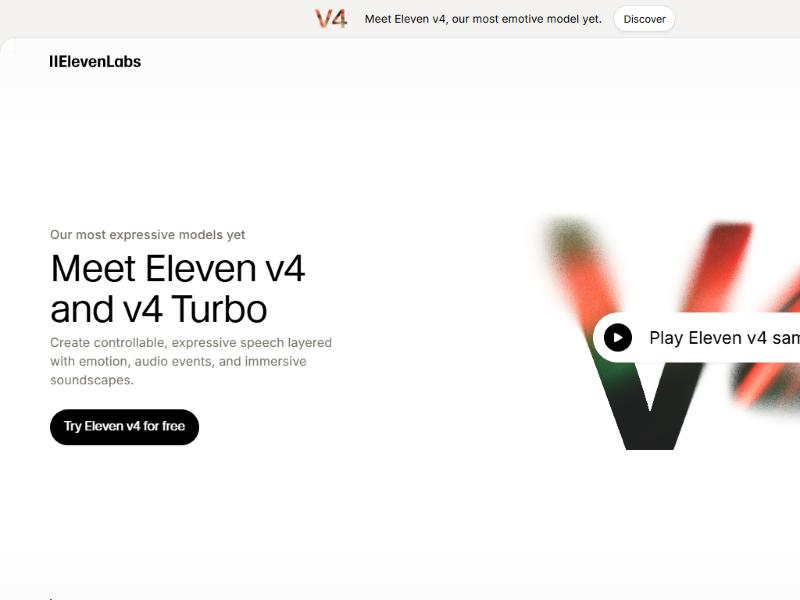
Eleven v4 is the model ElevenLabs now puts first in its apps and API, replacing Eleven v3 as the default for generating speech. The short version: 90+ languages instead of 70+, 10,000 characters per generation instead of 5,000, inline audio tags instead of SSML, professional voice clones back, and a Turbo variant for voice agents. The free tier reaches it at the same credit rate as every other model. Everything below is read from the vendor's v4 page and models documentation on October 16, 2026; no listening tests were run for this note.
Eleven v4 is a model, not a new product
You do not buy v4. It appears as an option in the Model selector of the ElevenLabs web app, as `eleven_v4` in the API, and, in its Turbo form, inside ElevenAgents. Every plan, including the free one, can select it, per the v4 page checked October 16, 2026.
The vendor describes it as "our most emotive model yet" and the first of a new generation. The models documentation now lists Eleven v3 as "our previous generation speech synthesis model", which is as close to a deprecation notice as the page gets.
If you are new to the platform, the ElevenLabs review covers the credit system, the free tier's non-commercial licence and the plan ladder. This note stays on what v4 changes.
Six changes the vendor states outright
- Languages: 90+ against 70+ on v3. The models documentation lists both figures side by side, checked October 16, 2026. The v4 page names each language rather than giving a total.
- Length per generation: 10,000 characters against 5,000. The documentation's character-limit table gives 10,000 for `eleven_v4` and 5,000 for `eleven_v3`, roughly ten minutes of audio instead of five. Long scripts use what the page calls context stitching to keep pacing even across joins.
- Professional Voice Clones are back. They were unsupported on v3. On v4 they return, and the v4 page says clones made before launch must be retrained on v4 one at a time from the voice's own menu.
- Speaker identity holds across regenerations. The v4 page states that re-generating one line should not change the narrator, and the documentation describes "reliable speaker preservation across long text generations."
- Audio tags replace SSML. Direction is written inline: [whispers], [pause], [excited], [door slams]. The v4 page says SSML tags, including the break tag, are disabled in v4, and that tag sequences are followed "more reliably than v3, sound effects included."
- Instant clones improved. The v4 FAQ claims instant clones on v4 "now outperform" the professional clones of the older Multilingual v2 model, from about ten seconds of audio. That is a vendor claim with no published benchmark behind it.
One claim circulating in press coverage is a pronunciation benchmark rising from 85.6 percent on v3 to 91.7 percent on v4. It does not appear on the v4 page or the models documentation we read, so treat it as a reported figure rather than a vendor one.
Audio tags change how you write a script
On older models you controlled delivery with SSML and with Style and Speed sliders. On v4 the control surface is the script itself. You write the direction in square brackets where you want it, and the model performs it.
The v4 page groups the tags in three families: delivery, such as [warm], [whispers], [uncertain] or [delighted]; pacing, such as [pause], [long pause] and [building]; and sound effects, such as [laughs], [crowd applause] and [Gong sounds]. Tags can be stacked in sequence.
Two older controls are gone. The documentation for v4 keeps the Stability and Similarity settings and drops Style and Speed. If a workflow depended on the Speed slider, it now depends on tags like [pause] and on how the script is punctuated.
For a free-tier user this matters because every regeneration costs credits, and the free plan's 10,000 credits is about ten minutes of speech. Writing tags into the script before the first generation is the cheap way to get the delivery you want; regenerating to tune it is the expensive way. The note on what AI credits actually mean walks through the same arithmetic for other vendors.
Turbo is for agents, and its latency figure has a footnote
Eleven v4 Turbo trades some quality for speed. The v4 page lists a median inference latency of about 100 ms and a median time to first speech of about 150 ms, and shows a chart against two competitors: 262 ms for Cartesia Sonic 3.6 and 814 ms for OpenAI GPT-4o mini TTS. Those are the vendor's own measurements.
The documentation marks the 100 ms figure with a dagger: it excludes application and network latency. A real call will be slower by however long your own stack and the network add. Anyone building a phone agent should measure the end-to-end number a caller hears, not the model number on the page.
Turbo is reached through ElevenAgents and through the Text to Dialogue WebSocket. The character-limit table gives no figure for `eleven_v4_turbo`, and the documentation does not say whether it works with the standard Text to Speech endpoints. Both gaps are worth a support question before you design around them.
What v4 costs, and what the free tier gets
Nothing changes on the meter. The v4 page states that v4 uses the same credit pricing as the other text-to-speech models, and the pricing page's rule still applies: one character of text is one credit. A 10,000-character generation, the maximum on v4, is 10,000 credits, which is exactly the free plan's monthly allowance.
- Free: $0, 10,000 credits a month, about ten minutes of speech, personal and non-commercial use only. v4 is selectable; professional clones are not.
- Starter: $6 a month, 30,000 credits, the first tier with a commercial licence and instant voice cloning. The pricing page showed a promotional first month at $1 until October 18.
- Creator: $22 a month, 121,000 credits, the first tier with a professional voice clone. Shown at $11 for the first month on the same promotion.
- Pro, Scale, Business: $99, $299 and $990 a month with 600,000, 1.8 million and 6 million credits.
Prices and credits are from elevenlabs.io/pricing as read on October 13 and 16, 2026. Annual billing is described as two months free. The current cards are on the ElevenLabs pricing page.
The licence line matters more than the model line for anyone publishing. Free-tier output stays non-commercial on v4 as on every other model, which the watermark and commercial-use note covers across vendors. A monetised video or client voiceover needs Starter at minimum.
Who should switch now, and who should wait
Four groups get a clear benefit from moving to v4 today.
- Narrators of long material, such as lessons, audiobooks and podcast scripts, because the 10,000-character ceiling halves the number of joins in a chapter.
- Anyone who needs one voice in several languages, since the v4 page says a cloned voice now speaks a different language with a native accent rather than carrying its original one.
- Teams that gave up on v3 because professional clones were missing. They are supported again.
- Voice-agent builders, who want Turbo rather than v4 itself, with the latency footnote above in mind.
Three groups should hold off for a cycle.
- Brands whose voice must keep its original accent in other languages. v4 drops it on purpose, and the vendor says a toggle is still a research project with no date.
- Teams with a large library of clones. Each instant and professional clone made before v4 has to be retrained individually.
- Anyone who preferred the sound of a voice on v3. The documentation is candid that v4 is more accurate, and accuracy is not the same as preference. Keep v3 generations until you have compared the two on your own script.
If your real need is music rather than speech, v4 does not touch it; Suno remains the dedicated option. If the raw material is a human recording to edit rather than a script to voice, Descript approaches the job from the editor's side. For spoken summaries of documents, NotebookLM generates audio from sources you upload.
How to test v4 on the free tier without burning the allowance
- Pick one 600-character paragraph from your real script, about a minute of speech, rather than a full page.
- Generate it once on v4 and once on v3 with the same voice. That is 1,200 credits, an eighth of the free month.
- Write the tags in before generating. One [pause] in the right place costs nothing; a regeneration to add it costs the full paragraph again.
- Use the free regenerations the documentation describes, two identical re-runs at no charge, before changing anything.
- Decide on the licence before the model. If the output goes anywhere that earns money, the Starter plan is the floor whatever model you pick. The free-tier checklist covers the same decision for other tools.
Bottom line
Eleven v4 is a genuine step: longer generations, more languages, inline direction, professional clones restored, and a fast variant for agents. None of it changes the two facts that decide most purchases, the one-character-one-credit meter and the non-commercial free licence.
Test it on a paragraph, not a page. Retrain clones one at a time. Measure Turbo end to end. And read the current plans on the day you commit, because the promotional first-month prices and the credit rates in the FAQ are the two things on that page that move.
Sources: the Eleven v4 product page at elevenlabs.io/v4, the models page in the ElevenLabs documentation, and elevenlabs.io/pricing, all read on October 16, 2026 (pricing also on October 13). Some outbound links on this page pay AI Souk a commission at no extra cost to you; the note was written before any link was added. See the method page for how this site works.