 AI
AI
Suno
Full songs from a text prompt, with a free tier that refills every day and a license that keeps everything personal until you pay.
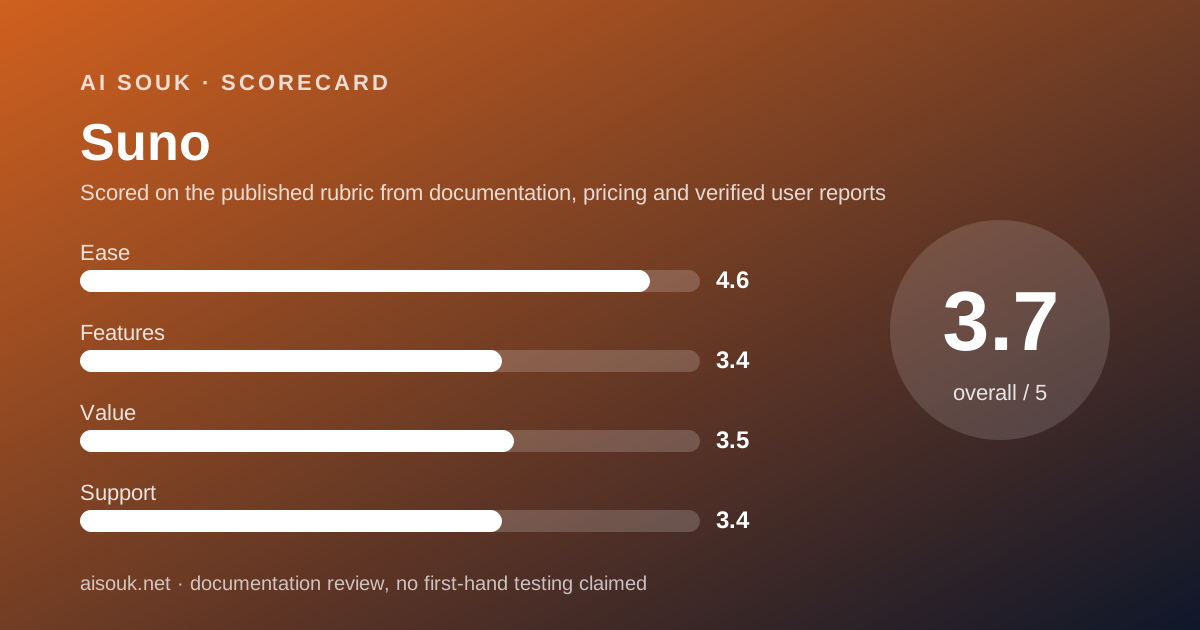
Scored on the published rubric, from documentation, pricing and verified user reports.
Best for: Anyone curious whether AI-generated music is usable for their purpose, who can experiment daily for free and does not need to download or publish anything commercially until they have decided.
Verdict
This is a documentation review, not a walkthrough: no account was opened for this page and no screenshots were captured, so nothing here is a first-hand claim about what the interface looks like today. On the documented design, Suno is the simplest product in this batch to understand. You describe a song, it generates one, and the free plan gives you 50 credits every day to do that with, per the pricing page checked October 7, 2026. The vendor's help centre says that daily allowance is enough for 10 songs. What the free plan does not give you is anything you can take away: the pricing page lists no monthly song downloads, no commercial rights, no stem separation and access only to the free models, and the terms of service restrict free-tier output to personal, non-commercial use. So the free tier is a generous sandbox with the door locked from the inside. The paid plans are cheap by the standards of this category, at $8 and $24 a month, and they are where the product becomes usable for anything beyond listening. The value score reflects that the free tier is honest about what it is, and that what it is falls short of a working tool.
Visit Suno
We have no affiliate relationship with this vendor. Link goes to the official site.
Where it is strong
- The allowance refills daily rather than monthly - 50 credits a day per the pricing page and help centre - so a free user can experiment every day indefinitely instead of burning a monthly budget in one sitting
- The help centre states plainly that 50 daily credits is enough for 10 songs, which is a rare case of a vendor publishing the song-to-credit relationship
- The paid tiers are inexpensive for the category: Pro at $8 a month with 2,500 credits and Premier at $24 with 10,000, with a 20% discount on annual billing, per the pricing page
- The terms are explicit about the line between personal and commercial use, so there is nothing to discover after publishing
- Audio upload exists even on the free plan - up to 8 minutes, per the pricing page - so you can test extending or reworking your own material
Where it falls short
- No monthly song downloads on the free plan, per the pricing page: you can make songs but not take the files away, which limits the free tier to listening inside the product
- No commercial rights on the free plan, and the terms of service tie commercial exploitation on paid plans to a permitted download, so even paid downloads are counted per month - 20 on Pro and 60 on Premier as of October 2026
- Free users get the free models only - the pricing page names v6-mini as the best free model - so the quality you hear on the free tier is not the quality the paid tiers produce
- The vendor does not publish a per-song credit cost on the pricing page; the help centre's figure of 10 songs a day was last edited well before this review and may not match current models
- Free credits do not accumulate: the pricing page says subscription credits do not carry over from day to day or month to month
What the free tier actually includes
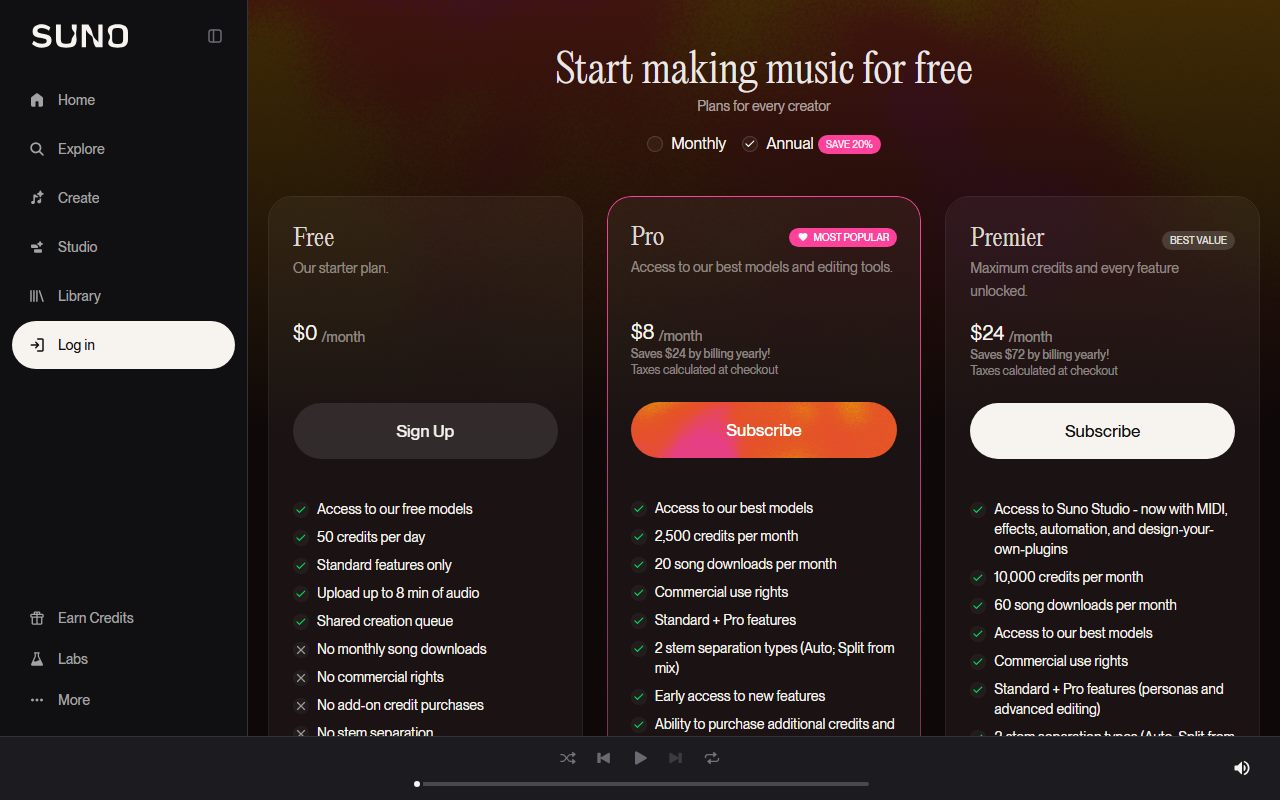
According to the pricing page, checked October 7, 2026, the Free plan is $0 and provides 50 credits per day. The help centre's article on plan types states that the free plan's 50 credits that replenish daily are enough to make 10 songs per day, and a separate article states that replenishment happens once daily on Coordinated Universal Time. That daily rhythm is the most important structural fact about the free tier: it is not a monthly budget you can exhaust in an afternoon, it is a small allowance that comes back tomorrow.
The pricing page lists the free plan as standard features only, with access to the vendor's free models, naming v6-mini as the best free model. It allows audio uploads of up to 8 minutes and places free users in a shared creation queue with 4 concurrent generations.
The list of exclusions on the same page is just as specific. No commercial rights. No monthly song downloads. No add-on credit purchases. No stem separation. The pricing page also states that credits included in subscriptions do not carry over from day to day or month to month.
The help centre adds one technical restriction: WAV file downloads are only available to Pro and Premier subscribers, and must be made from the website rather than the mobile app.
The practical reading is that a free user can generate, listen, iterate and share within the product every day, but cannot take a file away and cannot use the result in anything that earns money. For deciding whether the product is for you, that is plenty. For using it, it is a locked room.
- 50 credits per day, replenished daily on UTC (pricing page and help centre, October 7, 2026)
- Help centre states 50 credits is enough for 10 songs per day
- Free models only; v6-mini named as the best free model
- Audio upload up to 8 minutes; shared queue, 4 concurrent generations
- No commercial rights, no monthly song downloads, no add-on credits, no stem separation
What sits behind the paywall
The pricing page lists two paid plans. Pro is $8 a month, or $76.80 a year with the 20% annual discount, and includes 2,500 credits a month, access to the vendor's best models, 20 song downloads per month, commercial use rights, a priority queue of up to 10 songs at once, two stem separation types, and the ability to buy additional credits and downloads. Premier is $24 a month, or $230.40 a year, with 10,000 credits, 60 downloads a month, access to Suno Studio, three stem separation types and uploads of up to 30 minutes.
Two features of this structure are unusual and worth understanding before paying.
The first is that downloads are metered separately from credits. A Pro subscriber can generate hundreds of songs but may only download 20 of them a month without buying more. The terms of service connect this to the license: a paid user may commercially exploit output provided they have obtained a permitted download of it, and the terms state that the number of downloads permitted per month depends on the tier. In other words, the download is the license token. If you generate a track and use it commercially without a permitted download, you are outside the terms even on a paid plan.
The second is what happens at the end of a paid allowance. The help centre states that Pro and Premier users who reach their monthly allotment receive the same 50-credit daily allotment as free users until the next renewal. The plan does not go dead; it drops to the free rhythm.
The pricing page also notes that purchased top-up credits do not expire but require an active subscription to use, which is a detail that matters if you buy a bundle and then cancel.
Prices in this category change; read the current page before deciding, and check whether the figure shown is monthly or annual.
Who it is for, and who should skip it
The free tier is for the curious. If you want to know whether a text prompt can produce something you would be happy to play to another person, the free plan answers that every day at no cost, and the daily refill means you can keep refining prompts over a week without a bill. It is also a sensible place for a small business to explore whether AI music could plausibly replace a stock-music subscription, as long as nobody treats the free output as usable yet.
It is also for personal use in the plain sense: a birthday song, a joke for a group chat, a sketch for a hobby project that will never earn money. The terms of service permit exactly that and nothing more.
Who should skip the free tier and go straight to a decision about paying: anyone who needs the file. A podcaster who wants an intro, a video editor who wants a bed track, a shop that wants music for a promotional reel. None of those can be done with free output, because the pricing page lists no downloads and no commercial rights on the free plan, and the terms restrict free output to personal, non-commercial purposes. The free tier will show you whether the product can make what you want; it will not let you leave with it.
Who should skip the product entirely, at least for now: anyone whose use carries legal or brand risk around music rights. The terms say the vendor retains a perpetual right to identify that an output was generated via the service, and the broader question of how AI-generated music is treated for copyright and licensing purposes varies by jurisdiction and is not settled. A documentation review is not legal advice and the help centre's own article on copyright is careful on this point. If the music is going somewhere that matters, get a professional opinion.
Limits and what users report
The hard limits are the ones already listed: daily credits, model access, downloads, commercial rights, upload length and queue priority. The vendor publishes all of them on the pricing page, which is better than most of the category.
The soft limit that users on public forums most often describe is the gap between the free models and the paid ones. The pricing page itself frames the free tier as access to the free models and the paid tiers as access to the best models, and the user reports are consistent with that: people who liked the free output report liking the paid output more, and people who disliked the free output sometimes report that the paid models changed their view. This page cannot confirm the size of that gap and will not guess at it; it is the single most useful thing to test for yourself.
The second thing users report is the per-generation cost. The help centre's figure of 10 songs for 50 daily credits implies roughly 5 credits per song, but that article was last edited well before this review and the vendor does not publish a per-song cost on the pricing page. Newer models or longer generations may cost more. Treat the number as indicative, not exact, and watch your balance for the first day.
The third is the download meter on paid plans. Users who expected unlimited downloads on Pro report surprise at the 20-per-month figure. The pricing page is clear about it; the surprise comes from not reading it.
This page cannot verify today's limits. The pricing page and help centre can.
Privacy and data use
Four things to read in the vendor's own documents before putting anything you care about into this product, two of them standard and two specific to music.
Standard: whether your prompts, lyrics and uploaded audio are used to train or improve the models, and whether that differs by tier; and how long uploaded material is retained after you delete a song or close the account. Both belong in the privacy policy, and both are commonly assumed rather than checked.
Specific to music, first: ownership and the vendor's rights in the output. The terms of service say that free-tier output is for personal, non-commercial use only, and that paid users may commercially exploit output only with a permitted download. The terms also grant the vendor a perpetual, irrevocable right to identify to the public that any output was generated via the service. That is not a trivial clause for a brand. If you would be uncomfortable with a vendor publicly stating that your jingle was AI-generated, read that section before using the product for brand material.
Specific to music, second: what you upload. The free plan accepts audio uploads of up to 8 minutes, and the paid plans up to 30. Uploading a recording of a person singing, or of copyrighted music, raises questions about whether you have the right to do so, which the vendor's terms and community guidelines address and which this page will not summarise on their behalf.
This page cannot confirm current policy wording. Read the terms for the tier you are on.
Alternatives worth a look
The nearest neighbour in this batch is ElevenLabs, which lists music as one product alongside text to speech, sound effects and voice tools. Its free tier is monthly rather than daily and, per its pricing page, music is priced at a high per-minute credit rate, so a free user there gets far less music than a free user here. But it is the right choice if music is one part of an audio job that also involves narration or sound design, and like Suno its free output is non-commercial.
If the real task is editing audio you already recorded rather than generating new audio, Descript is a different kind of product: it transcribes a recording and lets you cut it by editing the text, with noise cleanup and filler-word removal on a credit system. A podcaster who wants an AI-generated intro and a cleaned-up episode would plausibly use both, and Descript's free plan is where the editing side can be evaluated.
None of these is a substitute for trying the free tier here for a few days, which costs nothing and answers the question that documentation cannot.
Frequently asked
How many songs can I make for free? The pricing page says 50 credits a day, and the help centre says that is enough for 10 songs per day, as of October 2026. The per-song cost is not published on the pricing page and may differ by model, so treat 10 as a guide rather than a guarantee.
Can I download the songs on the free plan? No. The pricing page lists no monthly song downloads for the free plan, and the help centre states WAV downloads are for Pro and Premier subscribers only.
Can I use a free song in a video, a podcast or an ad? No. The terms of service restrict free-tier output to personal, non-commercial use. Commercial rights come with the paid plans and, per the terms, are tied to a permitted download of the specific track.
Do unused daily credits add up? No. The pricing page states subscription credits do not carry over from day to day or month to month.
What happens when a Pro subscriber uses all 2,500 credits? The help centre says they receive the same 50-credit daily allotment as free users until the monthly renewal.
Is the free model the same as the paid one? No. The pricing page lists free models for the free plan and best models for the paid plans, and names v6-mini as the best free model.
Why no screenshots on this page? Because no account was opened for it. That is what a documentation review means here; the method page explains the distinction.
Does this page earn a commission? No. There is no affiliate relationship with this vendor; the link goes to the official site.
Bottom line
On the documented design, Suno's free tier is a well-shaped sandbox. The daily refill is a genuinely good idea for a product whose value you can only judge by ear: it lets a curious person keep listening and refining for as long as they like without ever being asked for a card. The help centre's figure of 10 songs a day is enough to form a real opinion within a week.
The sandbox has no exit. No downloads, no commercial rights, free models only. Every one of those is stated on the pricing page and in the terms, so none of it is a trick, but a reader should go in knowing that the free tier answers the question of whether the product can make what they want, and nothing more. The moment the answer is yes and the use is anything other than personal, the decision becomes whether $8 or $24 a month is worth it, and that decision should be made with the download meter and the license clause in mind.
If you try it, do three things. Compare what the free model produces against what you actually need. Read the terms section on commercial use and the vendor's right to identify output as generated. And if the music is going into anything with brand or legal weight, get an opinion from someone qualified before relying on a generated track.
What this page cannot tell you, stated plainly because the method requires it: how the songs sound, how large the gap is between the free and paid models, what the per-song credit cost is on today's models, or whether any limit above has changed. No account was opened and no screenshots were captured. The free plan refills tomorrow; go and listen.
Visit Suno
We have no affiliate relationship with this vendor. Link goes to the official site.