 AI
AItl;dv vs Fireflies.ai free: unlimited video that expires, or unlimited transcripts you cannot download
These two meeting recorders both say unlimited on their free plans and both mean something narrower. tl;dv records and transcribes every meeting with video, gives you AI notes on ten of them a month, and deletes free recordings after three months. Fireflies transcribes every meeting the bot auto-joins, rations the summaries with a small credit balance, records no video on free, caps storage at 400 minutes and will not let you download a transcript until you pay. Short answer: tl;dv for most solo users and small teams, by a narrow margin; Fireflies if the privacy paper or the integrations decide it. Figures are the vendors' own as of October 2026.
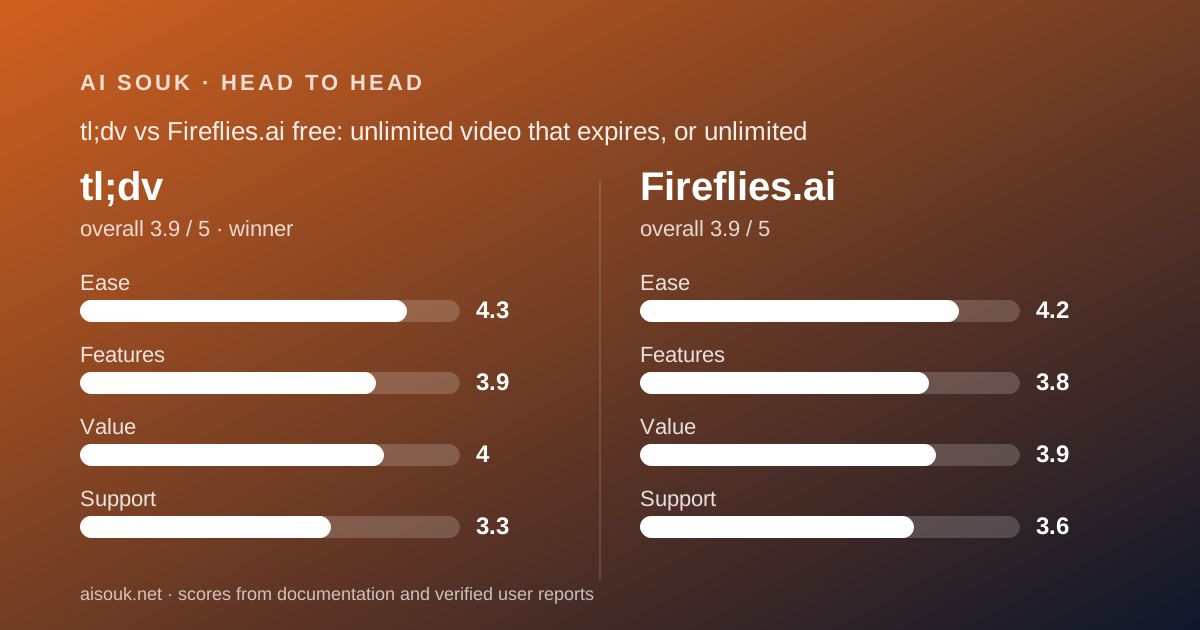
 3.9tl;dv
 3.9Fireflies.ai
The short answer
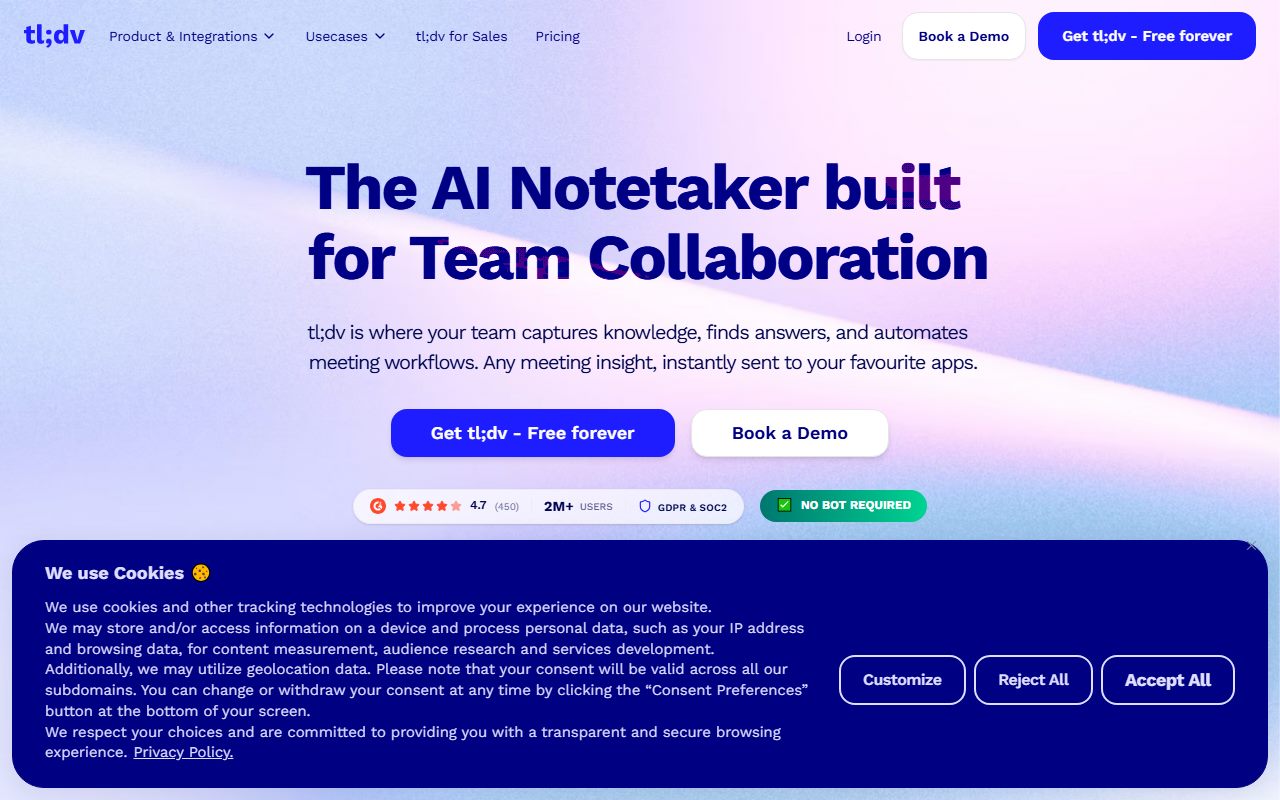
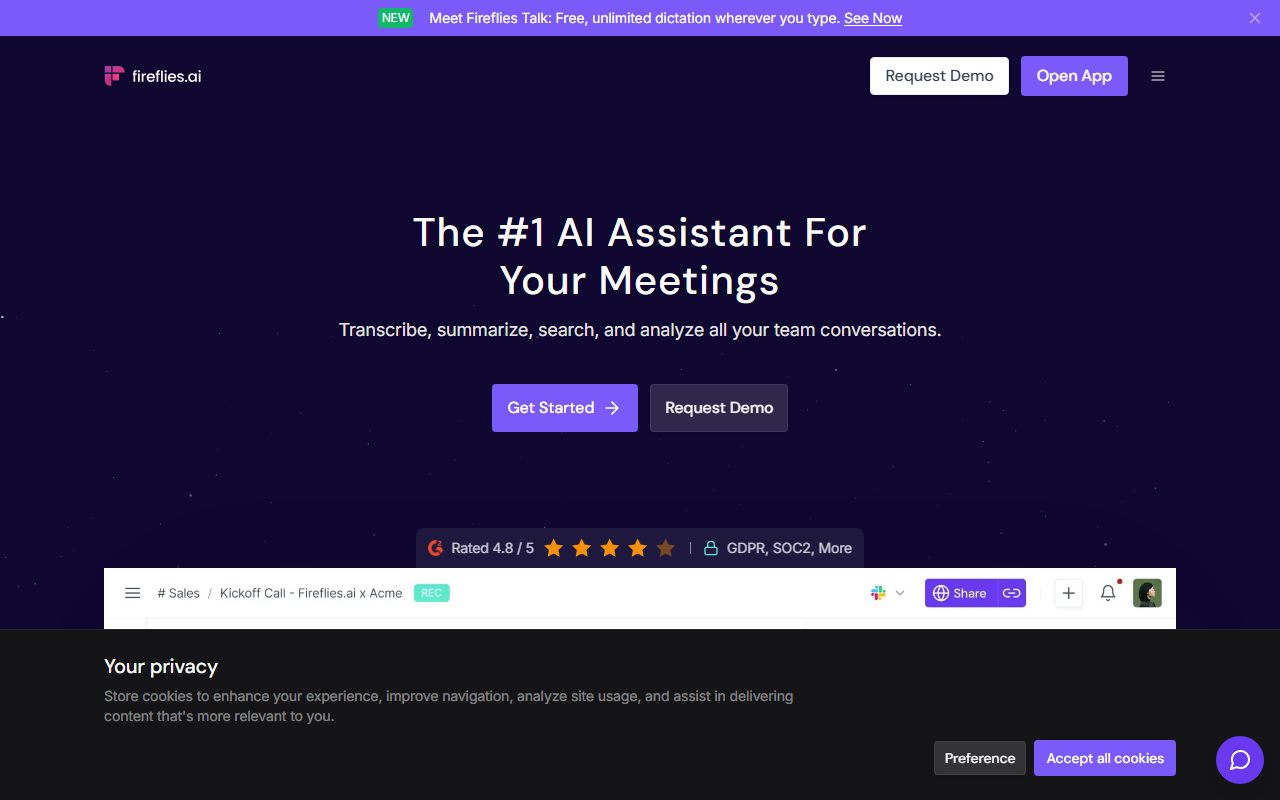
This is a documentation comparison. It uses tl;dv's features page, its July and August 2026 pricing explainers and its privacy policy, and Fireflies' pricing page, help center, billing page and privacy policy, all read October 7, 2026. One caveat belongs in the first paragraph: tl;dv's pricing page itself could not be retrieved on that date, so its figures come from the vendor's own posts and should be checked against the live page. No account was opened for this comparison. The single-product pages are tl;dv and Fireflies.ai.
tl;dv edges this comparison, and the margin is narrow enough to say so plainly. Its free plan gives you the raw material without limit, video, audio and transcript for every meeting across Zoom, Google Meet and Microsoft Teams, and rations the finished product to ten AI notes a month. Fireflies' free plan gives you transcription without limit only when the bot auto-joins from your calendar, rations summaries to a credit balance that starts in single digits, records no video, and keeps the result inside the product because downloads are paid.
Fireflies wins where its documentation is strongest: a privacy policy that states personal information is not used for training with zero data retention at its processors, an API and a Chrome extension on free, and a help center that spells out every rule. tl;dv's free archive expires after three months and its public documentation is thinner. If you want a recorder you can forget about, tl;dv; if you want a recorder whose paperwork you can show a client, Fireflies.
What each free tier includes (as of October 2026)
tl;dv's free plan, which the vendor calls Free Forever and describes as needing no card, is shaped like this across its July and August 2026 posts and its features page. Recording and transcription are unlimited: the features page states the free plan includes unlimited transcriptions and video recordings, across Zoom, Google Meet and Microsoft Teams, in more than 30 languages, with transcripts that show who said what. The AI layer is capped: ten meetings with AI notes a month, ten Ask tl;dv queries, and five uploads, with one July post also listing ten multi-meeting AI reports. Retention is three months for free users, stated in the August post and in the privacy policy.
Fireflies' free plan, per its pricing page the same day: unlimited transcription with an asterisk, limited AI summaries, 400 minutes of storage per team (a help article says per seat), 20 AI credits, the Zoom, Meet and Teams bot, transcription in more than 100 languages, real-time notes, meeting search, the AskFred assistant, audio and video upload up to 100 MB and 150 minutes per file, two-hour meetings, desktop and mobile apps, a Chrome extension, 50-plus integrations and API access. The asterisk, per the help center: a new account gets three transcription credits on the web, five via the extension or ten on mobile, one per meeting, unless the auto-join calendar toggle is on, in which case credits are spent only on summaries and transcription is uncapped. Video recording is listed from Pro upward, and the help center states transcript downloads require a paid plan.
Side by side: tl;dv's free plan includes video and Fireflies' does not. tl;dv states its AI cap as a number, ten a month; Fireflies says limited and leaves the summary count to the credit mechanism. tl;dv allows five uploads; Fireflies allows uploads within file-size limits. tl;dv's archive lasts three months; Fireflies' archive is bounded by 400 minutes of storage. Fireflies' free plan has an API and a Chrome extension; tl;dv's posts list API, webhooks and an MCP server under Pro.
Daily limits and what happens when you hit them
On tl;dv, the limit people meet first is the ten AI notes. Because recording is unlimited, new users assume the whole product is, and the eleventh meeting of the month has a transcript but no summary. That is the documented behaviour, and the sensible response is to decide in advance which meetings earn a note. The limit people meet last and resent most is retention: the privacy policy states free users' recordings are kept for three months, and the vendor's August 2026 post warns explicitly that the free plan is not somewhere to build an archive you expect to find next year. Users on public forums describe discovering this when looking for a recording from a previous quarter. One July post says free recordings archive after three days, which this site reads as an error given the policy says months; check the live page.
On Fireflies, the limit people meet first is summaries. With auto-join on, transcripts keep coming and the summary credits run down; users on public forums report running out faster than expected, which is the documented behaviour. The 20 AI credits for AI Skills, the assistant and voice agents are described on the billing page as one-time and in one help article as monthly; assume one-time. The limit people meet later is storage: 400 minutes is a rolling cap, not a monthly refill, and what happens to recordings beyond it is a question for the current help center. The help center also notes the present rules apply to accounts created on or after September 1, 2026.
What happens at the wall differs in kind. On tl;dv the wall is time: the recording you did not export is gone at three months. On Fireflies the wall is a door: the recording is still there, within the storage cap, but the transcript cannot leave the product without a paid plan. A user who exports on a schedule is fine on tl;dv; a user who only needs to read inside the app is fine on Fireflies.
Quality of output for everyday work
Transcript quality across 30-plus or 100-plus languages cannot be graded from documentation, and this page will not. Both vendors claim automatic speaker identification; both are reported publicly to handle clean audio well and crosstalk poorly, as every product in this category is.
The output you can hold differs. tl;dv's free output is a video recording with a timestamped transcript and, for ten meetings a month, AI notes; its Pro posts describe custom note templates, action-item assignment and follow-up email drafts as paid. Fireflies' free output is a transcript with real-time notes, a summary while credits last, meeting search and AskFred answers across your meetings; video, downloads and advanced exporting are paid, and the help center states that summaries, transcription and recap emails are never charged in AI credits, which means the recap email is a free output even when the AI Skills credits are gone.
For a solo consultant, the everyday difference is video. Being able to scrub back to the moment a client pointed at a slide is something tl;dv's free plan gives and Fireflies' does not. For a sales team, the everyday difference is the integrations and the API: Fireflies lists 50-plus integrations and API access on free, so the notes can flow into a CRM without a download; tl;dv lists Zapier access and developer tools under Pro, and five uploads and limited downloads on free.
The bot-in-the-room issue is identical. Both join from the calendar; both are the subject of the same public complaint from participants who did not expect a recorder. tl;dv's policy states it collects consent from non-client participants before the meeting, which suggests a notification mechanism; Fireflies documents controls over which meetings the bot joins. Neither transfers the legal obligation. Say you are recording.
Privacy and training defaults
Both vendors state that customer content is not used to train models, which puts this pair ahead of Otter on this site, and the differences are in retention and jurisdiction.
tl;dv's privacy policy, read October 7, 2026, states that tldx Solutions GmbH does not use customer content to train, fine-tune or improve foundation models, will not sell collected data, and that staff do not access recordings unless a user grants support access. Retention is tiered: free users' recordings are kept for three months, paying users' until account deletion. The company is German, frames compliance under GDPR, names its hosting providers as certified to ISO 27001, PCI DSS and SOC 1 and 2, and describes a right to erasure through its data protection officer.
Fireflies' privacy policy, read the same day, states that the vendor does not use personal information for AI model training, contractually prohibits its vendors from doing so, and does not collect, use or sell personal data for training large language models. It describes zero data retention at its third-party processors: audio, video, transcripts and summaries are not stored, accessed or trained on after processing. Account data is deleted within 30 days of closure. A help article lists SOC 2 Type II and GDPR compliance, which is a feature list rather than a certificate.
For a European buyer, tl;dv's German operator and GDPR framing may matter; for a buyer who wants the processors' handling of content spelled out, Fireflies' zero-retention language is the more specific statement. The three-month expiry on tl;dv's free plan is a privacy feature as much as a limitation: a free archive that deletes itself is one fewer thing to secure. Neither free plan is the instrument for regulated or confidential work; both vendors sell Business and Enterprise paper for that, and the decision belongs with whoever owns the risk.
Price of the first paid step
tl;dv Pro is the consistent figure across the vendor's July 27 and August 11, 2026 posts: $18 per seat per month billed annually, or $29 billed monthly. The Business tier is inconsistent in the same sources, $29 annually or $39 monthly in two posts and $59 per user in a third, and this page will not pick one. Pro removes the AI-notes cap, adds custom templates, action-item assignment, follow-up email drafting, global transcript search, unlimited uploads and storage, Zapier access to more than 5,000 integrations, and developer access through an MCP server, API and webhooks. Retention moves from three months to until account deletion.
Fireflies Pro is $18 per seat per month billed monthly or $10 billed annually; Business is $29 monthly or $19 annually; Enterprise is $39 per seat annually. Pro raises storage from 400 to 8,000 minutes per seat, adds video recording, makes transcripts, summaries and recordings downloadable, and brings more transcription credits and advanced exporting. Business adds unlimited storage, API analytics, private channels and three-hour meetings.
On annual billing the first step is $10 on Fireflies against $18 on tl;dv, and the gap is wide enough to matter for a small team. What the step buys is the mirror image of the free plans: Fireflies Pro buys the video and the downloads that tl;dv gives away free, and tl;dv Pro buys the unlimited AI notes and the permanent archive that Fireflies' free plan already approximates through storage rather than time. A team that stays free on tl;dv and exports on a schedule may never need Pro; a team that stays free on Fireflies and needs the notes in another system will need Pro in the first month. Both vendors change prices; tl;dv's pricing page was unreachable when this was written, so verify its figures first.
Pick this one if…
Pick tl;dv if you want video on a free plan. It is the only one of the two that records it without paying, and the only one whose free AI cap is a published number.
Pick tl;dv if you have a few important meetings a month and read transcripts for the rest. Ten AI notes covers the client calls; the unlimited transcript covers the internal ones.
Pick Fireflies if the notes have to leave the product through an integration rather than a download. Fifty-plus integrations and API access on free is a real difference for a team with a CRM.
Pick Fireflies if a procurement reviewer will read the privacy policy. Zero data retention at processors and an explicit no-training statement is the paper that survives that review.
Pick tl;dv if you are in the EU and want a German operator under GDPR, and you are comfortable exporting anything that matters before the three-month expiry. Pick Fireflies if the first upgrade budget is $10 a seat rather than $18.
Frequently asked
Which one actually gives more free transcription? Both say unlimited and both mean it, with conditions. tl;dv's condition is time: three months, then gone. Fireflies' condition is configuration: auto-join must be on, and the archive is bounded by 400 minutes of storage. For a user who records several hours a week, tl;dv's archive is deeper within its window; for a user who records occasionally, Fireflies' storage may never fill.
Can either be trusted with client calls on the free plan? Both state they do not train on your content, which is necessary but not sufficient. A free consumer account sits on consumer terms, consent for recording is your obligation under both policies, and regulated work belongs on a paid business plan with a decision from whoever owns the risk. The free plans are for finding out whether the habit sticks.
What about Otter? Otter.ai gives 300 minutes a month with a 30-minute cap per conversation and documents every limit precisely, but its privacy policy states it trains on de-identified recordings and transcriptions, which is the reason it is not the recommendation here. If you only need notes and your meetings are short, read that page; if you want to turn the recordings into something else afterwards, Descript is the editing tool on this site that takes a transcript as its starting point.
Visit tl;dv
We have no affiliate relationship with this vendor. Link goes to the official site.
Visit Fireflies.ai
We have no affiliate relationship with this vendor. Link goes to the official site.